We Read the Quest Diagnostics Filing. No Actor, No Vector, No Indicators — Here Is What Defenders Can Actually Do.

Quest Diagnostics told the SEC that someone got into one of its systems. Within a day, the internet knew how many patients were affected, which fields were taken, and who did it.
Quest has not said any of those things. Neither has anyone else who was actually there.
Here is what the primary sources say, what they deliberately do not say, and why the gap between those two is the only part of this story a defender can use this week.
What the company actually filed
On October 21, 2026, Quest learned of unauthorized access to Quanum LSM, the system certain clients use to place test orders and look up results. The company filed a Form 8-K the following day.
The filing's own language is careful, and the care is informative. It says the company initiated its cybersecurity incident response procedures to contain the activity, assess and investigate the nature and scope of the incident, and implement remedial measures. It says federal law enforcement was notified and outside cybersecurity experts were engaged. On scope it says the full extent of unauthorized access remains under investigation, and that at this time the company believes an unauthorized party accessed certain patient records.
"Certain patient records." Not a number. Not a field list.
By 7:00 pm Eastern on October 23, Quest said it had remediated the incident and securely restored the system. Core business operations were not impacted, and clients using direct laboratory information system interfaces or EMR integrations were not affected.
There is one more detail worth noting, because it tells you how the company is sizing this internally. In the same reporting period Quest raised its full-year revenue and earnings guidance, and the incident appears in that release only once, as a forward-looking risk factor. A company that believed it was sitting on a catastrophe does not usually raise guidance in the same breath.
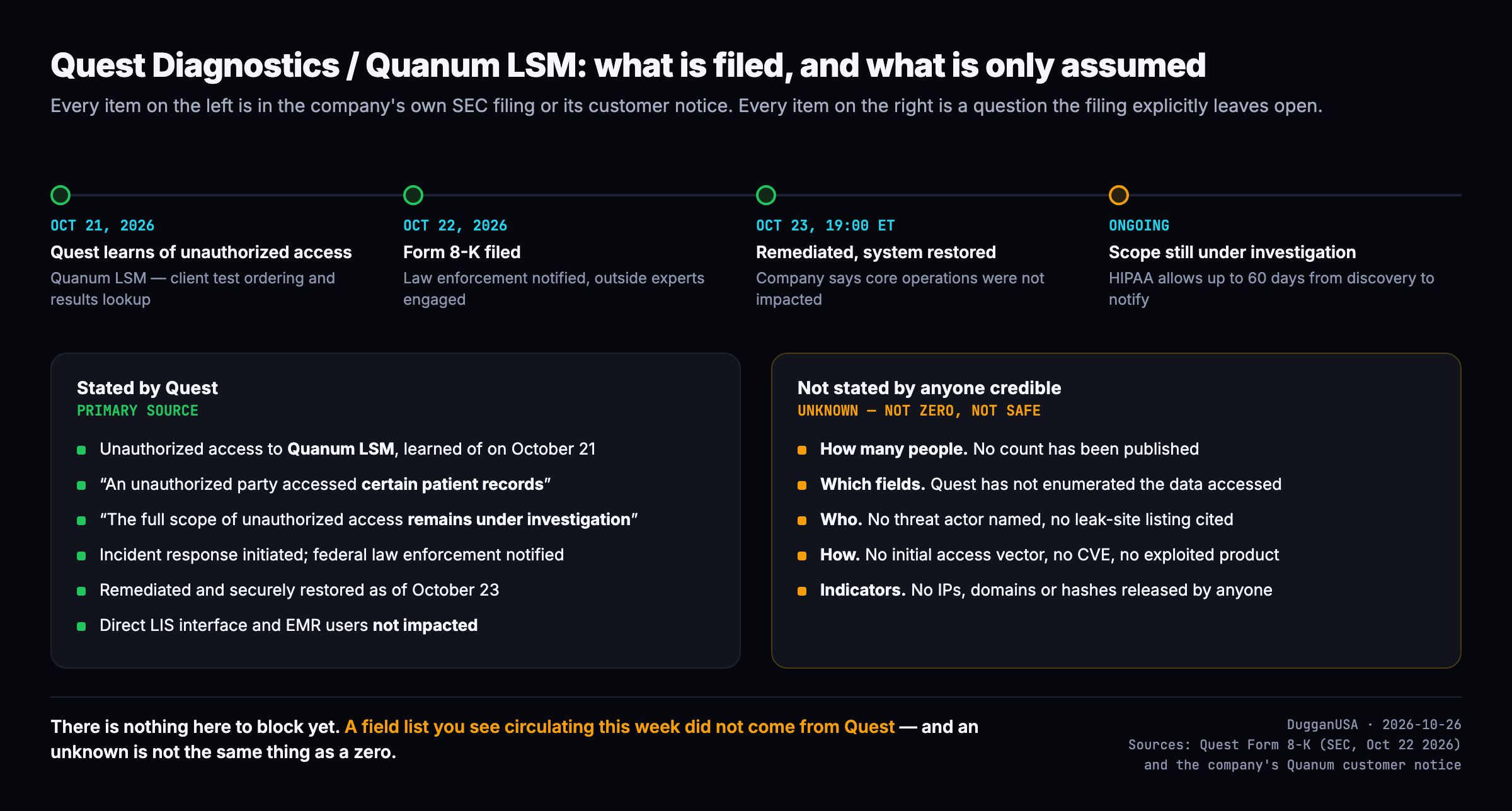
The five things nobody knows
No published count of affected people. No enumeration of which data fields were accessed. No named threat actor and no leak-site listing. No initial access vector, no CVE, no exploited product. And no indicators of compromise from anyone: not an IP, not a domain, not a hash.
That last one is the whole operational story. There is nothing here to block. If you are a defender hoping to turn this week's headline into a firewall rule, there is no rule to write yet, and anyone selling you one is selling you something else.
Under HIPAA the clock runs up to sixty days from discovery for individual notification. That means the real numbers land in December at the latest, and they will land from Quest or from the Office for Civil Rights portal, not from a press cycle in October.
Unknown is not zero, and it is not safe either
We say this constantly about our own instruments and it applies with equal force to somebody else's incident: a thing you have not measured is not a thing that measured zero.
When a filing says scope is under investigation, that sentence carries no information about size. It is equally consistent with a handful of records and with millions. Treating it as reassurance is a mistake, and treating it as confirmation of catastrophe is the same mistake wearing a different hat. Both substitute a guess for a measurement and then forget they did.
The practical version: if you see a specific field list for this breach circulating this week, check where it came from. If the trail ends at a law firm's landing page or an aggregator site rather than at Quest or a regulator, you are reading marketing copy, not intelligence. Several such pages went up within days, and that is a business, not a disclosure.
What a defender can do today
Three things, none of which require knowing the scope.
Find out whether you touch Quanum LSM at all. It is a client-facing ordering and results system, so the exposure question is not "am I a Quest patient" but "does my organization place orders or pull results through that portal." If yes, your credentials for that system are the asset to care about, and rotating them costs you an afternoon and settles the question.
Check your own logs for the window, not for indicators. You do not have IOCs and you are not getting them soon. What you do have is a date range: access was discovered October 21 and the system was restored October 23. If you integrate with that portal, pull your authentication and data-export records for the surrounding period and look at volume rather than signatures. An anomaly in how much was pulled is visible without knowing who pulled it.
Write the notification trigger down now. If you are a covered entity or a business associate downstream of this, your own clock may start when Quest tells you something, not when you read a headline. Decide today who receives that notice and what it obliges you to do, while nobody is panicking.
Why we are publishing a post with no indicators in it
Our feed exists to give people things to block, and this post hands over nothing. We are publishing it anyway, because the alternative on a week like this is the thing we keep arguing against: a confident write-up assembled from other people's summaries, with a number in the headline that no primary source supports.
We hold a long run of healthcare breach coverage, and the reason it is worth anything is that each entry says where its facts came from and marks the gaps as gaps. Omnicell, CareCloud, iRhythm, Abbott. Every one of those had a week like this one, where the pressure to publish a number arrived well before the number existed.
The honest product here is the shape of the uncertainty: what is confirmed, what is open, and when the real figures are due. That is checkable today and it will still be true in December, which is more than most of this week's coverage will manage.
We will update when Quest or the regulator publishes a count. Ninety-five percent confidence, and on this one the missing five percent is simply time.
Every indicator in this post is in the feed. Free.
1.58M+ IOCs, STIX 2.1 / TAXII, 88% novel vs ThreatFox, exploited-CVE leads ahead of CISA. No credit card — a free API key in 30 seconds, and you can audit every claim above against the live endpoints.
Get your free key → analytics.dugganusa.com/stix/register
Was this useful? Thirty seconds, no cookies, no tracking, no third parties, your address hashed and never stored. If the box below does not load, the same question lives at https://analytics.dugganusa.com/nps.html?post=we-read-the-quest-diagnostics-filing-no-actor-no-vector-no-indicators-here-is-what-defenders-ca