A Windows Infostealer Now Asks an AI Model Which Victims Are Worth Your Time. Here Is What to Hunt For, and the One Hash We Hold.

Cisco Talos published an analysis of VOLTA-AUTODOXER, a Windows infostealer that does the usual theft and then adds a step: it sends what it stole to a hosted language model and asks for a ranking of how much the victim is worth. Talos first saw it on October 11. It does not describe how the malware reaches victims, and it observed no servers owned by the operator. Every endpoint in the report belongs to a third-party service.
What it does
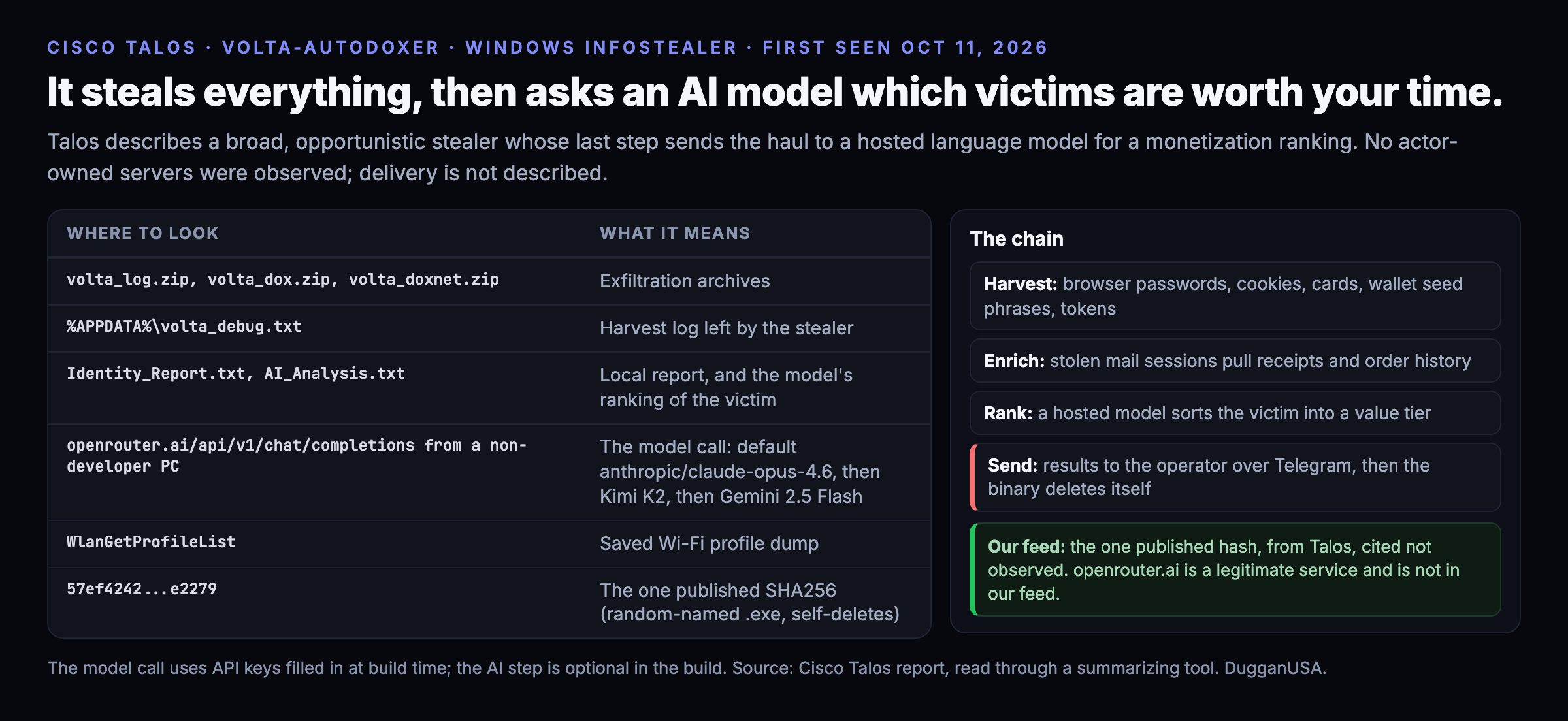
VOLTA harvests browser passwords, cookies, payment cards, crypto wallet seed phrases and session tokens, plus saved Wi-Fi profiles. Stolen mail sessions are used to pull purchase receipts and food-delivery order history, and a Discord profile lookup adds more. It writes a local report, then packages the data and posts it to OpenRouter with a system prompt. The default model is Anthropic's Claude Opus 4.6; if that model refuses, it falls back to Kimi K2 and then Gemini 2.5 Flash. The model's answer, saved as AI_Analysis.txt, places the victim in a value tier. Results go to the operator over Telegram, and the executable deletes itself.
Two caveats from the report matter. The AI step is a build option, and Talos calls the integration narrow: the model reads text and returns a tier, and the stealing itself is ordinary. The model call uses API keys filled into a template at build time. Talos does not say whose keys they are, so we do not either.
What to hunt for
- The archives volta_log.zip, volta_dox.zip and volta_doxnet.zip, and the file volta_debug.txt in the user's AppData folder.
- Identity_Report.txt and AI_Analysis.txt written outside any tool you recognize.
- Outbound HTTPS to openrouter.ai from machines that have no business calling a model API. A developer's laptop does. A finance workstation or a kiosk does not. This is a question about the machine, not a reason to block the service.
- The API call that lists saved Wi-Fi profiles, from a process that is not a network tool.
What we hold, and what we don't
We hold the one hash Talos published, a SHA256 for a sample compiled on August 17, added at confidence 85 under the source manual-batch-volta-autodoxer-talos-2026-11. It is an ingest of Talos's research, not our detection and not a lead. There is nothing network-side to add: the only endpoints are OpenRouter and a lookup site, both legitimate services that must never land on a blocklist, and the report publishes no Telegram identifiers.
Limits
This rests on coverage of the Talos report, and on the report itself read through a summarizing tool. We did not analyze the sample. One blog gives a different first-seen date than Talos's October 11, and we have used Talos's. The delivery vector is unknown, so the hunt list above covers what the malware leaves behind, not how it arrives.
Five percent of this is wrong somewhere. It always is. The numbers will move again before you finish reading.
Was this useful? Rate this post. The widget is at the bottom of the page, and we read every response.
Every indicator in this post is in the feed. Free.
1.58M+ IOCs, STIX 2.1 / TAXII, 88% novel vs ThreatFox, exploited-CVE leads ahead of CISA. No credit card — a free API key in 30 seconds, and you can audit every claim above against the live endpoints.