Tor's Emergency DDoS Fix Reached Half the Network in Five Days. Our Hourly Consensus Record Shows the Other Half, and a Guard Count That Fell a Third

If you run a Tor relay or bridge, upgrade to Tor 0.4.9.17 now; the Tor Project says no other action is needed after the upgrade. If you host an onion service, the Tor Project's announcement gives you no specific instruction, but make sure the tor daemon behind it is a current 0.4.9 release: the October 28 release notes say Tor 0.4.8 and earlier "will no longer work on the network." If you only use Tor Browser, the announcement asks nothing of you; keep Tor Browser updated as usual.
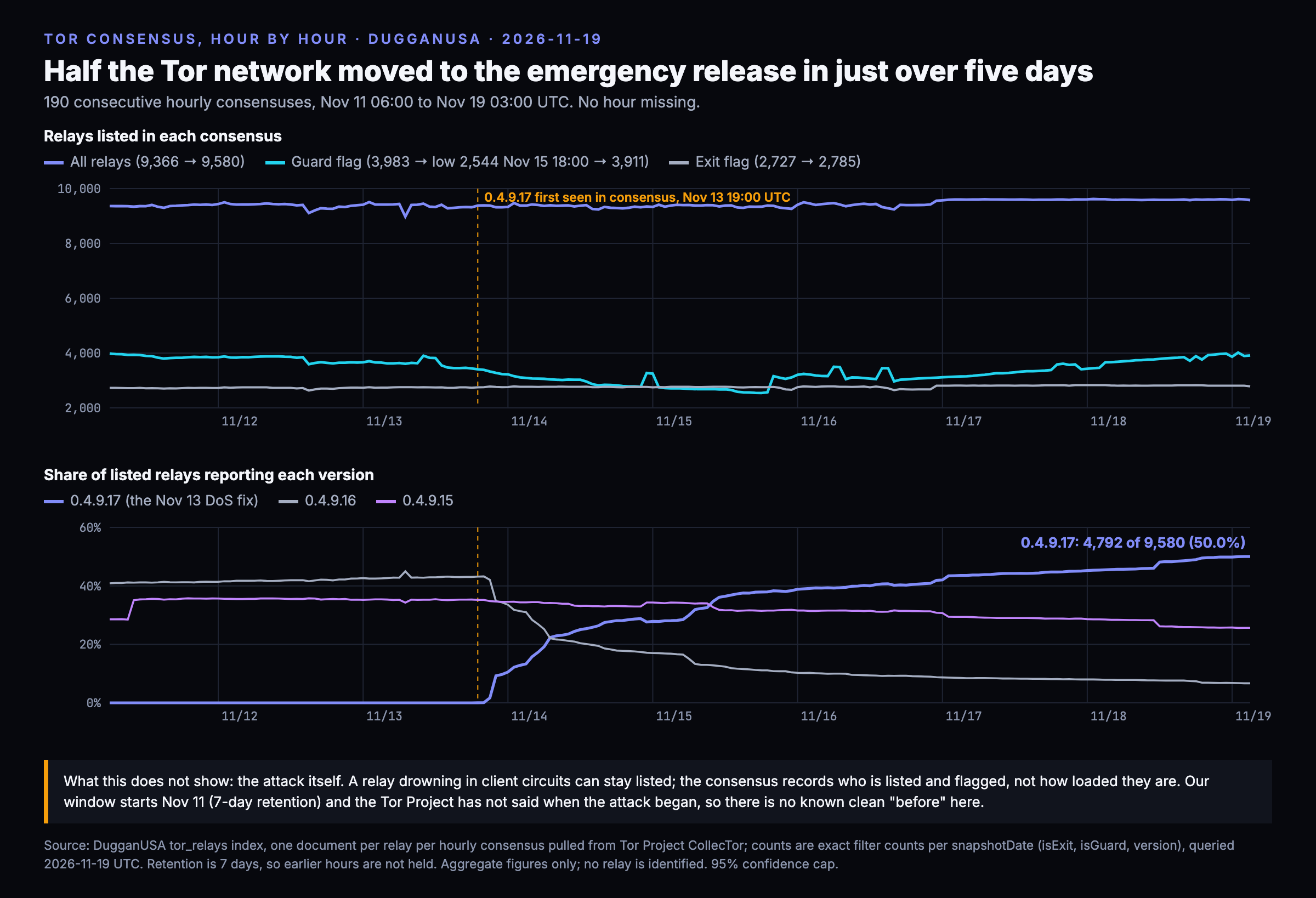
As of 03:00 UTC on November 19, half the relays in the Tor consensus, 4,792 of 9,580, reported running 0.4.9.17. The other 4,788 had not upgraded yet, five days after the release.
What the Tor Project says
The primary source is the Tor Project's own release announcement on its forum, "Security Release 0.4.9.17," posted by Tor developer David Goulet, and the 0.4.9.x release notes in the Tor GitLab repository, which date the release to Friday, November 13, 2026. BleepingComputer reported it on November 17. Both trace to that one announcement; this is one source, not two.
The announcement says: "This release comes in rapid response to the ongoing DDoS attack on the network, which has affected most relay operators." It describes relays across the network being flooded with client circuits, a problem the project calls hard to solve. It says one fix "in particular is especially important for relay DoS defenses related to IPv6 handling," that the team is "actively evaluating additional defenses and so expect further releases in the near future," and it ends with "Thank you to all… except our attacker(s)."
The release notes spell out that fix. Relays now track IPv6 clients by their /64 prefix instead of by each individual address (TROVE-2026-031, bug 41344). In plain terms: before this release, a client holding a block of IPv6 addresses could look like thousands of separate clients to a relay's per-client limits. Now one /64 counts as one client, and the client counts relays report in their statistics change the same way.
The same notes carry three other items worth knowing:
- A directory authority was pulled. "Remove the keys for bastet due to a potential compromise. It can be reinstated with new keys later." Bastet is one of the directory authorities that vote on the consensus. The notes give no detail beyond that sentence, and the Tor Project does not connect it to the DDoS. Neither do we.
- Another authority moved. The maatuska directory authority changed IP address (ticket 41487), and the fallback directory list was regenerated on November 13.
- A client-side security fix. Tor now rejects a RESOLVED cell carrying a hostname record that is not a valid DNS name (TROVE-2026-075, bug 41464).
This is the third security or emergency release in under three weeks. 0.4.9.15 (Wednesday, October 28) added defenses against large volumes of directory requests to relays. 0.4.9.16 (Wednesday, November 4) was an emergency release for directory authorities only, fixing a "thundering herd" caused by new required protocol versions. 0.4.9.17 followed nine days later.
What is not known
The Tor Project has not said who is behind the attack, when it began, or what the attacker wants. Its announcement names relays as the thing being flooded; it does not name onion services, specific sites or the directory authorities as targets. It published no attacker indicators, no source networks and no traffic signatures in the sources we read (the forum announcement, the 0.4.9.x release notes, the Tor blog's front page and the Tor status page, which listed no November incident when we checked it on November 19). There is nothing to put in a blocklist, and we added nothing to our feed.
What our hourly consensus record shows
We pull every hourly Tor consensus from the Tor Project's CollecTor archive into an index, one record per relay per hour. Before using it, we checked that it was alive: the newest consensus we hold is 03:00 UTC on November 19, collected about 40 minutes after the hour, and we hold all 190 hours from 06:00 UTC on November 11 onward with none missing. CollecTor's own public listing of recent consensuses shows all 96 hours from November 15 04:00 to November 19 03:00, so for at least those four days the directory authorities published a consensus every hour, attack or not. We keep seven days of hourly snapshots, so we cannot show you October.
Every count below is an exact count of relay records for one consensus hour, not a sample.
The network did not shrink. Relays listed per consensus stayed between 8,976 and 9,618 the whole week. The lowest hour was 07:00 UTC on November 13, a one-hour dip of about 460 relays that recovered the next hour. Since about 23:00 UTC on November 16 the count has held near 9,600, slightly higher than the 9,300 to 9,450 of the days before. Exit-flagged relays barely moved: 2,727 at the start, 2,785 at the end, never below 2,633.
The Guard flag fell by a third, then came back. Relays carrying the Guard flag, the ones Tor clients use as their first hop, went from 3,983 on November 11 at 06:00 to 2,544 on November 15 at 18:00, a 36 percent drop, then recovered to 3,911 by November 19 at 03:00. The directory authorities award the Guard flag from their own measurements of each relay's uptime and bandwidth, and the consensus keeps a flag only when a majority of voting authorities agree. A flooded relay, an authority that cannot measure well, or a change in which authorities vote could each move this number. The consensus does not tell us which, and the Tor Project has not explained it, so we are reporting the movement, not a cause.
Upgrades came fast, then slowed. 0.4.9.17 first showed up in the consensus at 19:00 UTC on November 13 (2 relays), passed 859 by 22:00, reached 2,099 (22 percent) by 07:00 the next morning, 3,060 by November 15, 4,216 by November 17, and 4,792 (50.0 percent) by November 19 at 03:00. The same hour, 2,457 relays still reported 0.4.9.15 and 638 still reported 0.4.9.16. The remaining 1,693 reported other versions.
What this record cannot show is the attack itself. A relay drowning in client circuits can stay listed in the consensus. The consensus records who is listed and flagged, not how loaded each relay is or what its users are experiencing. All of the above is aggregate: we do not identify, rank or single out any relay.
Am I affected?
Relay and bridge operators. Run tor --version, or read the "Tor 0.4.9.x" line near the top of your tor log after a restart. Anything below 0.4.9.17 needs the upgrade. On Debian or Ubuntu with the Tor Project's repository, apt policy tor shows what is installed and what is available. If you run the webtunnel bridge Docker image thetorproject/webtunnel-bridge, a commenter on the Tor forum noted on November 17 that the Docker Hub listing looked about five months old; check the image's tor version yourself rather than assuming a pull fixed it.
Onion-service hosts. The announcement says nothing about onion services. Check the version of the tor daemon your service runs with the same tor --version. If it is 0.4.8 or older, the October 28 release notes say it will no longer work on the network; move to current 0.4.9.
Tor Browser users. Nothing in this announcement is aimed at you. Slow or failing connections this week may be the network, not your computer. Keep Tor Browser updated through its built-in updater.
How we know
- Tor Project forum, "Security Release 0.4.9.17," announcement by David Goulet, November 13, 2026: forum.torproject.org/t/security-release-0-4-9-17/22454
- Tor 0.4.9.x release notes (entries for 0.4.9.15, 0.4.9.16 and 0.4.9.17), gitlab.torproject.org/tpo/core/tor, branch release-0.4.9, file ReleaseNotes, read November 19
- Tor Project CollecTor, recent relay consensuses listing, read November 19
- BleepingComputer, "Tor releases emergency update amid ongoing DDoS attack," November 17, 2026
- DugganUSA tor_relays index: exact per-hour filter counts on snapshot date, exit flag, guard flag and version, for every hour from November 11 06:00 to November 19 03:00 UTC, queried November 19
We did not test the attack, and we did not visit any onion service for this post. Weekdays were computed from the calendar, not from memory. As always, cap our confidence at 95 percent.
Read next: We Mapped 19 Tor Snapshots. Most Exits Are Run by Privacy NGOs., our first look at who runs the Tor network, built from the same consensus index.
Every indicator in this post is in the feed. Free.
1.58M+ IOCs, STIX 2.1 / TAXII, 88% novel vs ThreatFox, exploited-CVE leads ahead of CISA. No credit card — a free API key in 30 seconds, and you can audit every claim above against the live endpoints.