We Checked the Front Doors of 21 Threat-Intel Vendors, Ourselves Included. A Two-Person Shop Eating Its Own Dogfood Came Second

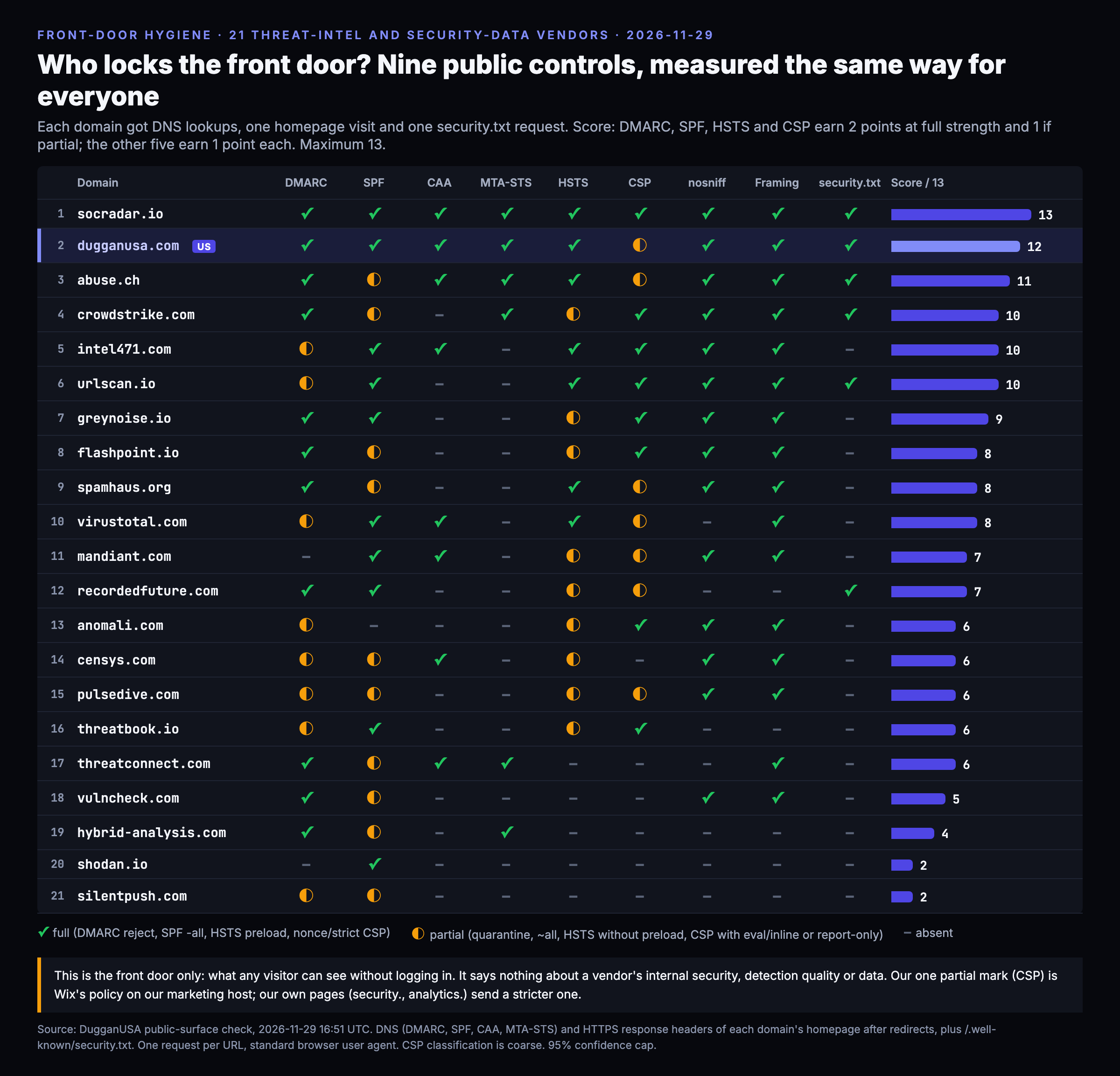
Do this first, whoever you are: check your own domain for the nine things in the table below. Six of them are free DNS records or one response header, and most take minutes. The fix list is at the bottom.
We sell threat intelligence. So this afternoon we asked the question a careful buyer would: do the people selling security lock their own front door? We measured 21 threat-intel and security-data vendors the same way, ourselves included, and ranked the results.
What we found
- SOCRadar scored a perfect 13. Hat tip. Every control, at full strength.
- We came second with 12. Our one partial mark is the content security policy on www, which is Wix's, not ours (more below).
- abuse.ch third with 11. The free-feed people run a tight ship, as anyone who uses their data would hope.
- Only 4 of 21 have DMARC at reject, CAA and MTA-STS together: SOCRadar, abuse.ch, ThreatConnect and us. Those three records decide whether someone can send email as you, get a certificate issued for you, or downgrade the encryption on your inbound mail.
- 6 of 21 publish a security.txt, the file that tells a researcher where to report a bug in your product. For security vendors, that is a low number.
- 2 of 21 have no DMARC record at all, so receiving mail servers get no instruction about mail forged in their name.
Nobody at the bottom of this table is bad at security. These are the front doors only. A low score usually means the website belongs to marketing, the mail domain to IT, and nobody owns the gap between them.
The power of eating our own dogfood
Here is the part we are proud of. We are two people. We do not have a security team, a compliance department or an annual budget for a SOC 2 auditor. What we have is the habit of running our own product on ourselves first, and fixing what it finds the same day.
- CAA records, so only three certificate authorities may issue certificates for our domain (one of today's twelve points: this morning we would have tied abuse.ch at 11).
- Our own block pages on Cloudflare's WAF and IP blocks, so a blocked person reads a plain explanation and a way to reach us instead of a generic error.
- A stricter content security policy on our analytics site: unsafe-eval removed after thirteen days of report-only data showed no real page needed it.
- Our threat feeds now refuse to serve a short file. If a source fails, a subscriber gets an error and retries, never a quietly incomplete blocklist.
- A watchdog that emails us when a scheduled job stops running, which found a broken job on its very first check.
None of that is clever. It is the same checklist we would hand a customer, run on ourselves, with the evidence kept: every change has a commit, a signed approval and a deploy record. That is the whole pitch. If our front door is locked, we can tell you how to lock yours, because we just did it.
What we could not see, and our one partial mark
- This measures the front door, not the house. DNS records and the response headers of one homepage say nothing about a vendor's internal security, data quality or how fast they respond to incidents. Use it as a conversation starter, not a verdict.
- Our CSP mark is Wix's. dugganusa.com redirects to our Wix-hosted site, and Wix sends its own policy that allows eval. We cannot change it. Our own pages, security.dugganusa.com and analytics.dugganusa.com, send stricter policies. Scored on those, we would tie for first. We kept the honest number.
- The CSP check is coarse. A policy using nonces counts as strict even if it also lists unsafe-inline, which modern browsers ignore in that case. A careful manual review could move a vendor up or down by a point.
- It is one day's snapshot, taken 2026-11-29 around 16:51 UTC.
Am I locked? The free fix list
Check your own domain with any DNS lookup tool and your browser's developer tools (Network tab, response headers):
- DMARC: a TXT record at _dmarc.yourdomain ending in p=reject once your reports show legitimate mail passing. Start at p=none with a reporting address if you are not sure.
- SPF: a TXT record at your domain ending in -all (hard fail), not ~all.
- CAA: a CAA record naming only the certificate authorities you actually use. Check which ones issue your current certificates first, or renewals will fail.
- MTA-STS: a _mta-sts TXT record plus a policy file, so other mail servers must use encryption to reach you.
- HSTS: a Strict-Transport-Security header with a long max-age, includeSubDomains, and preload once you are sure every subdomain serves HTTPS.
- CSP: a Content-Security-Policy header. Ship it as Content-Security-Policy-Report-Only first, read the reports for a week or two, then enforce.
- nosniff: X-Content-Type-Options: nosniff.
- Framing protection: frame-ancestors in your CSP, or X-Frame-Options.
- security.txt: a file at /.well-known/security.txt with a Contact: line.
If you run Cloudflare, items 1 through 4 are DNS records you can add in the dashboard today, and our open-source Edge Shield adds blocking from our feed in front of your site for free.
Want the threat feed we dogfood behind all of this? Register for a free key and read the docs.
How we measured
For each domain: DNS lookups for DMARC, SPF, CAA and MTA-STS; one HTTPS request to the homepage (following redirects) to read its security headers; and one request for /.well-known/security.txt. One request per URL, a standard browser user agent, no scanning, no login, nothing a normal visitor would not do. Scoring: DMARC, SPF, HSTS and CSP earn 2 points at full strength and 1 if partial; CAA, MTA-STS, nosniff, framing and security.txt earn 1 each. Maximum 13. The script and raw results are ours and we will share them with any vendor on the list who asks.
Read next: A year of our edge canaries, scored against MITRE ATLAS and D3FEND.
Every indicator in this post is in the feed. Free.
1.58M+ IOCs, STIX 2.1 / TAXII, 88% novel vs ThreatFox, exploited-CVE leads ahead of CISA. No credit card — a free API key in 30 seconds, and you can audit every claim above against the live endpoints.