This Morning's Brief Told Us Oracle E-Business Suite Was Being Exploited. The Source Says Scanning. That One Word Is the Difference Between a Fire Drill and a Patch Window.
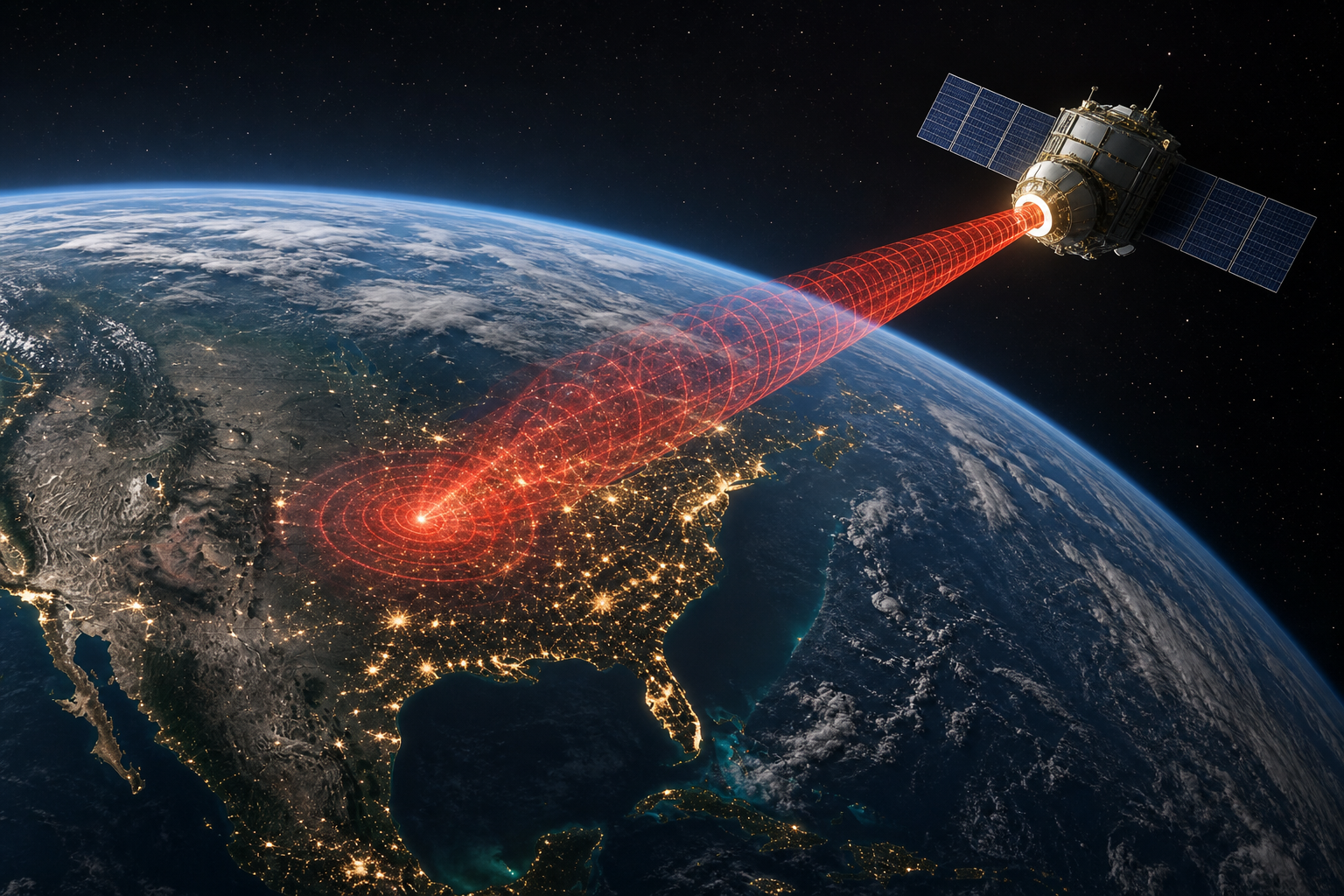
Our own morning threat sweep handed us this item today, ranked as the number one action:
Hackers target critical Oracle E-Business Suite RCE days after patch — Rapid post-patch scanning and exploitation of a critical RCE.
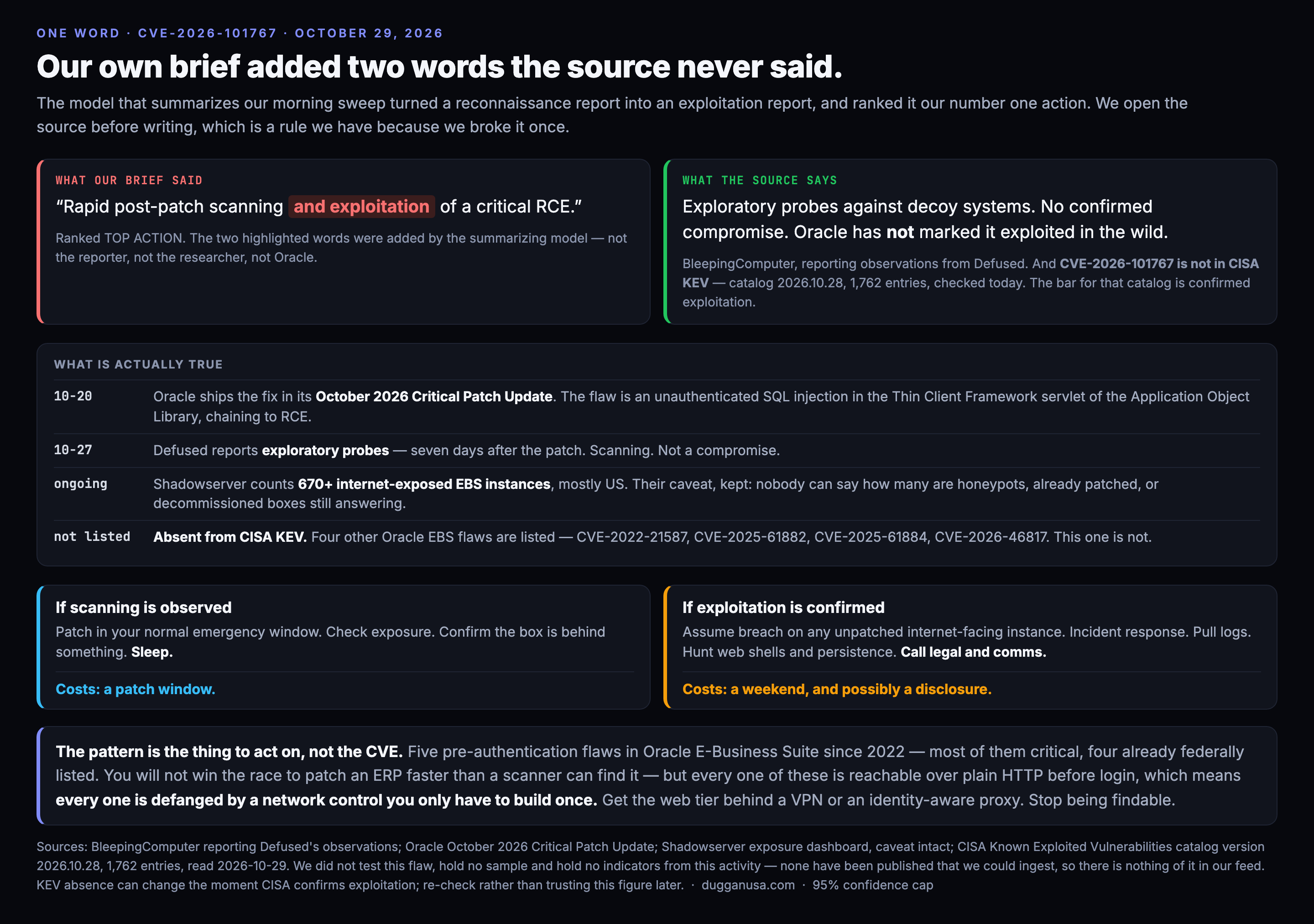
We opened the source before writing anything, which is a rule we have because we broke it once. The source — BleepingComputer, reporting on observations from Defused — says scanning. It says exploratory probes against decoy systems. It does not report a single confirmed compromise, and Oracle has not marked the flaw as exploited in the wild.
The words "and exploitation" were added by the language model that summarizes our brief. Not by the reporter, not by the researcher, not by Oracle.
This is a small post about that one word, because that word is the difference between a Thursday and a very bad Thursday, and because the mechanism that produced it is running in a lot of security programs right now.
What is actually true
CVE-2026-101767. Oracle E-Business Suite, in the Application Object Library component. Defused describes it as an unauthenticated SQL injection in the Thin Client Framework servlet that chains to remote code execution. That is a serious bug and nobody should relax about it.
Oracle shipped the fix in its October 2026 Critical Patch Update on October 20. Defused reported exploratory probes on the morning of October 27 — seven days later.
Shadowserver counts more than 670 internet-exposed Oracle EBS instances, mostly on US addresses. That number deserves a caveat the headline figure never carries: Shadowserver cannot tell you how many of those are honeypots, how many are already patched, or how many are decommissioned boxes still answering on port 443.
And the part that matters for your prioritization: CVE-2026-101767 is not in CISA's Known Exploited Vulnerabilities catalog. We checked the catalog directly — version 2026.10.28, 1,762 entries, pulled today. It is not there. Four other Oracle E-Business Suite flaws are: CVE-2022-21587, CVE-2025-61882, CVE-2025-61884 and CVE-2026-46817. This one is not, because the bar for that catalog is confirmed exploitation, and confirmed exploitation is exactly what has not happened yet.
Scanning is not exploitation, and the gap is where your week lives
Somebody running a scanner against 670 hosts to see which ones answer is reconnaissance. It tells you the clock has started. It does not tell you anyone has succeeded, and it very specifically does not tell you that you have been compromised.
The difference in what you should do is not subtle:
Scanning observed means patch in your normal emergency window. Check your exposure. Confirm the box is behind something. Sleep.
Exploitation confirmed means assume breach on any unpatched internet-facing instance, go to incident response, pull logs, hunt for web shells and persistence, and start the conversation with your legal and communications people.
One of those costs a patch window. The other costs a weekend and possibly a disclosure. Conflating them does not make you safer — it burns the credibility you need the next time something genuinely is being exploited, and it spends your team's attention, which is the most finite resource in any security program.
The third E-Business Suite bug in a year, which is the real story
We wrote about Oracle EBS on July 12 under the headline "Oracle E-Business Suite Got a 9.8 Unauthenticated Takeover. Attackers Were Inside Before a PoC Existed. That's the Third One in Nine Months." That was CVE-2026-46817, a different bug in a different component — Oracle Payments, improper privilege management, added to KEV on July 15.
So this is not that one. It is a new flaw, in a different component, found and patched three months later.
Four EBS entries in the federal must-patch catalog, spanning 2022 to this year — most of them critical, one rated high — and now a fifth unauthenticated flaw patched this month with scanners already looking for it. The pattern is the thing to act on, and the pattern is straightforward: Oracle E-Business Suite is an ERP system with an internet-facing web tier and a steady supply of pre-authentication remote code execution. If yours is reachable from the public internet, the specific CVE matters much less than that sentence does.
What to do today
Apply the October 2026 Critical Patch Update if you run E-Business Suite. It is seven days old.
Then do the thing that survives the next one: get the web tier off the public internet. Put it behind a VPN or an identity-aware proxy. Every one of the five bugs above is pre-authentication and reachable over HTTP, which means every one of them is defanged by a network control you only have to build once. You will not win the race to patch an ERP faster than a scanner can find it. You can win by not being findable.
Check your logs for the window between October 20 and today. Not because we know of a compromise — we do not — but because seven days of scanning against a known-exposed population is exactly the window where you would find the first attempt.
If you want a list of the infrastructure doing the scanning in general, ours is free, needs no sales call, and you set the confidence floor rather than us: the IP, domain and hash feeds are at analytics.dugganusa.com/api/v1/stix-feed.
The brief is ours, and we are publishing its error on purpose
Our morning sweep runs on our own infrastructure, built from five security RSS feeds and a model that clusters and summarizes them. It costs us almost nothing and it is genuinely useful. It also, today, turned "scanning" into "scanning and exploitation," and ranked it as our top action.
We have been here before. On October 8 the same brief described an LMCache flaw as a cache side-channel attack; it was an unauthenticated deserialization bug over a network socket. Two days ago it reported a campaign called "Gheist" that does not exist — the real name was GhostAction, which we had already covered, so a story we had published read back to us as a gap.
The rule we wrote after those, and followed today: treat the brief's headline as a lead and its description as unverified. Open the source before the item becomes a post. An automated summary is a reading suggestion, not a finding. If you run something similar — and increasingly everyone does — the failure mode is not that it hallucinates wildly. It is that it adds one plausible clause to an otherwise accurate sentence, and plausible clauses are the hard ones to catch.
There is also a quieter failure in the same brief, which we will write up separately: it graded twelve items today and never graded the biggest story in its own feeds.
Limits
We did not test CVE-2026-101767, we have no sample, and we hold no indicators from this activity — none have been published that we could ingest, so there is nothing of it in our feed and we are not implying there is.
The vulnerability description is Defused's characterization as carried by BleepingComputer. The patch date is Oracle's. The exposure count is Shadowserver's, with their caveat intact. The KEV absence is ours, measured against catalog version 2026.10.28 today, and it can change the moment CISA confirms exploitation — if you are reading this later, re-check rather than trusting this sentence.
Our July 12 post concerned a different CVE in a different component; we are not claiming prior coverage of this flaw, because we have none.
Five percent of this is wrong somewhere. It always is.
Was this useful? Rate this post — the widget is at the bottom of the page, and we read every response. If you run EBS and saw something in the October 20 to 29 window, that is the reply we want most.
Every indicator in this post is in the feed. Free.
1.58M+ IOCs, STIX 2.1 / TAXII, 88% novel vs ThreatFox, exploited-CVE leads ahead of CISA. No credit card — a free API key in 30 seconds, and you can audit every claim above against the live endpoints.