PLAID's KARTE Breach Exposed the Keys 754 Companies Used to Connect It to Their Other Services. If You Ever Used KARTE, Rotate Them Now: Mail Sent With Your Own Key Passes DMARC
If your company uses KARTE now, or ever did:
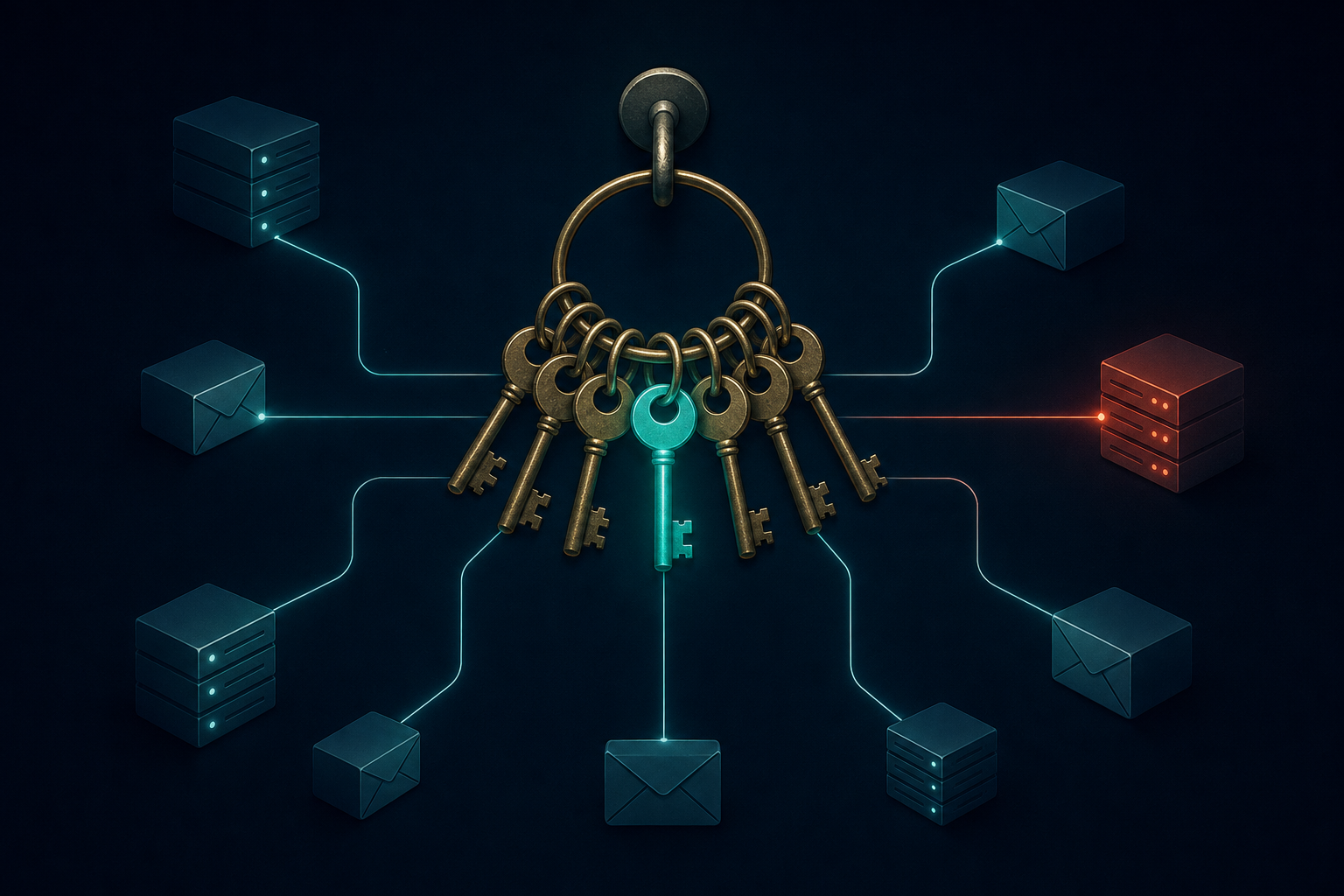
- Rotate every credential KARTE held for your other services, today. PLAID says the attacker obtained "authentication credentials used for integration with external services," which it describes as keys or passwords used to connect KARTE with other services "such as email delivery services," for 754 client companies. Think email delivery (your ESP), CRM, ad platforms, messaging (LINE, SMS), push notification services, data warehouses and storage buckets. PLAID invalidated the credentials it stole from its own systems; it cannot invalidate the keys you issued to it at a third party. Only you can, at each of those services.
- Read those services' logs back to November 13. Look for sends, exports and API calls from IP addresses you do not recognize, new API keys or users you did not create, and changed webhooks or sender settings. If KARTE is suspended (it has been since November 13), any call made with the KARTE key since then is not KARTE.
- Watch for phishing sent through your own mail service. A message sent with your stolen ESP key goes out from your real sending infrastructure, signed with your real DKIM key, from your real domain. It passes SPF, DKIM and DMARC because, technically, it is your mail. DMARC will not catch this. Your ESP's send log will.
- If you were a former KARTE client, ask PLAID whether your data was still there. PLAID admits it kept data from companies whose contracts had ended, which its own terms said should have been deleted, and that its first notice left those companies out. It also says the contact details it holds for old clients may no longer work. Its dedicated contact for former clients is [email protected].
- Prepare customer notices. If personal data you loaded into KARTE was in scope, Japan's Act on the Protection of Personal Information (APPI) generally requires a report to the Personal Information Protection Commission and notice to the people affected when a leak comes from unauthorized access. PLAID began sending each company its detailed data from November 24. Check the timelines with counsel; ours is not legal advice.
If you are a customer of a Japanese site or app: expect convincing phishing that really does come from a brand's own mail domain, mentions something you really bought, and knows your birthdate. Never click a "verify your account" or "confirm your order" link. Type the site's address yourself.
What is confirmed
We read PLAID's English investigation update of November 20, 2026, "Notice of Investigation Results Regarding Unauthorized Access to KARTE and Outlook for Service Resumption," and New Balance Japan's own notice of November 26. Everything below comes from those two documents.
The attack, as PLAID describes it:
- In the early hours of Friday, November 13, 2026, a third party "made intermittent attack attempts against multiple pathways" into PLAID's systems and "exploited a vulnerability in the internal processing of part of a public-facing pathway used for data retrieval."
- Through that flaw it "illicitly obtained certain data," and with authentication credentials found in that data it got into the KARTE administration console.
- PLAID suspended all KARTE services on November 13, invalidated the stolen credentials, blocked the attack source, and notified clients.
- It finished its internal investigation by November 19 and published the results on November 20.
What leaked, by category of client data (PLAID's counts of affected companies; companies overlap, so these do not add up to a total):
- 570 companies: part of the data they had loaded into KARTE themselves, such as member information. For some, personal information. Disclosed November 16.
- 487 companies: part of their end users' analytics data, meaning behavior on their sites and apps (page views, clicks) and data derived from it, such as membership rank. For some, personal information. Disclosed November 20.
- 409 companies (PLAID's estimated maximum): end-user cache data, temporary data that includes end-user identifiers and may include personal information. PLAID says it cannot tell which cache data was read, so it is treating all of it as possibly leaked.
- 754 companies: the keys or passwords KARTE used to connect to other services. PLAID notes these contain no personal information. They do not need to: they are the keys to the systems that hold it. Disclosed November 16.
PLAID's own data: 79,249 email addresses registered as KARTE (and Wicle) login accounts, and 45,816 sales and support contacts (names, email addresses and similar).
Former clients: PLAID's November 16 notice said only current clients were affected. The November 20 update corrects that: data from companies whose contracts had ended was retained "due to deficiencies in manual operations and in the management structure," and was taken too. PLAID says it is keeping that data until a third-party forensic investigation finishes, then deleting it.
What comes next: PLAID says KARTE needs "a fundamental rebuild, including the system architecture," with a phased restart targeted for mid-January 2027, a third-party forensic investigation, and no usage fees for November 2026 or the suspension period.
A named client, from its own notice: New Balance Japan says KARTE data on members of its official online store was affected: customer number, gender, date of birth and last product purchased, up to about 3.74 million records, plus about 120,000 hashed email addresses. It says names, phone numbers, cards and passwords were not included. Our New Balance Japan post has the details.
BleepingComputer also reports KARTE-related leaks at other Japanese companies, including ZOZO, DHC, Peach Aviation, World Co., Shimamura and Goldwin. We have not read those companies' own notices, so we are reporting those names on BleepingComputer's word only.
What is not known
- Who did it. PLAID does not name an attacker, and we will not guess.
- The flaw. No CVE, no component, no version. "A public-facing pathway used for data retrieval" is all PLAID says.
- Which keys, for which company. PLAID gives a count (754) and an example (email delivery services), not the list. Each company has to learn its own from PLAID's detailed data or from its own KARTE settings.
- Whether any stolen key has been used. PLAID does not say whether it saw use of the third-party keys after the theft. It could not see that anyway: the use would show up at the ESP or CRM, in the client's logs, not PLAID's.
- How many people. PLAID counts companies and, for its own data, records. No one has published a count of individuals across all clients.
What we fed
Nothing. No indicators were published in the sources we read: PLAID's update gives no attacker IP addresses, domains or file hashes, and New Balance Japan's notice gives none either.
Am I affected?
If you are a company:
- Did you ever have a PLAID contract or a KARTE (or Wicle) account? Check procurement and accounts payable, not only marketing; KARTE has been sold since March 2015, and teams change. A tag on your site loading from KARTE's domains is a strong hint you are a current client. Former clients are in scope too.
- List every integration configured in KARTE. For each one, find the key or password at the other end and rotate it. If KARTE is down and you cannot read its settings, go the other way: in your ESP, CRM, ad and messaging accounts, list API keys and look for any labeled for KARTE or PLAID, or created by the marketing team around KARTE's rollout.
- Read the send and API logs at each of those services from November 13 forward, looking for unfamiliar source IPs, unusual send volume, new templates or recipient lists, and bulk exports.
- Ask PLAID for your detailed data if you have not received it. Current clients: your PLAID representative or [email protected]. Former clients: [email protected].
If you are a consumer:
- Watch for an email from a company you shop with about this incident; New Balance Japan, for one, says it is emailing affected customers. Confirm it by going to the company's site yourself, not through a link in the message.
- Treat any message asking you to "verify," "re-confirm" or "log in to keep your account" as phishing until proven otherwise, even when it comes from the brand's real address.
- PLAID's inquiry form for end users is at plaid.co.jp/notice/202611-faq/.
Sources
- PLAID, Inc., "Notice of Investigation Results Regarding Unauthorized Access to KARTE and Outlook for Service Resumption," November 20, 2026 (English PDF on PLAID's investor-relations host, pdf.irpocket.com). It references PLAID's earlier notices of November 13 and November 16, which we did not read separately.
- New Balance Japan, "Apology and notice regarding a personal information leak caused by unauthorized access to an external service," November 26, 2026 (Japanese): company.newbalance.jp/press/2026/p-74134
- BleepingComputer, Bill Toulas, "New Balance Japan suffers breach exposing 3.7 million customer records," November 29, 2026
Read next: New Balance Japan's 3.74 million records came out through KARTE.
Every indicator in this post is in the feed. Free.
1.58M+ IOCs, STIX 2.1 / TAXII, 88% novel vs ThreatFox, exploited-CVE leads ahead of CISA. No credit card — a free API key in 30 seconds, and you can audit every claim above against the live endpoints.