OpenAI Says a Pipeline Produced 948 Working Linux Root Exploits for $1.2 Million. The Headline Says Patched. The Numbers Say Exploits, About $1,280 Each.

OpenAI says an agent pipeline built on an upcoming cyber model went from 2,308 candidate Linux kernel findings to 948 working local privilege escalation exploits in a run in mid-October, for $1,213,430 in API credits. That works out to about $1,280 per exploit. If you run Linux, the practical reading is OpenAI's own: a low-privileged account on an unpatched system should be treated as equivalent to root for anyone with resources, so patch cadence on kernels matters more than it did last year.
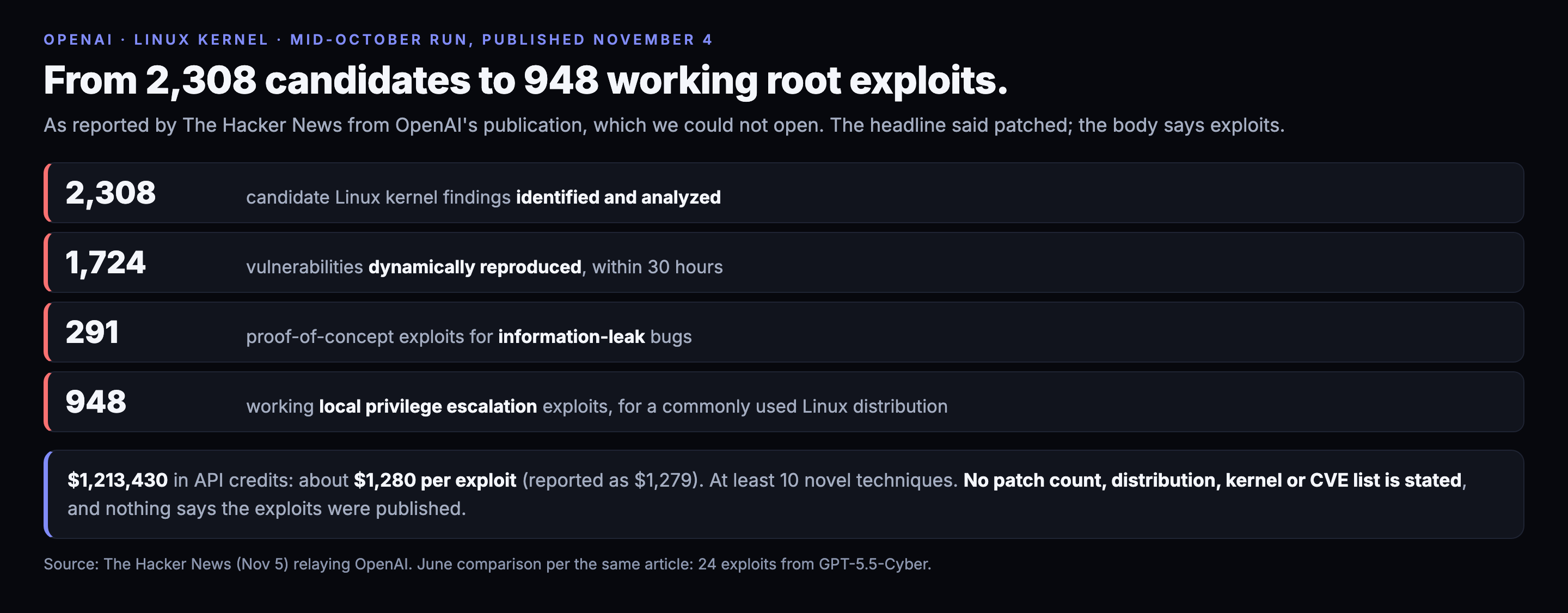
What was reported
This is from The Hacker News's account of an OpenAI publication, "A thousand fewer paths to root," which came out on Wednesday, November 4. OpenAI's own page returned HTTP 403 to us, so every figure below is The Hacker News's reading of it.
- 2,308 candidate Linux kernel findings were identified and analyzed.
- 1,724 vulnerabilities were dynamically reproduced, within 30 hours.
- 291 proofs of concept were produced for information-leak bugs.
- 948 working local privilege escalation exploits were produced for what OpenAI calls a commonly used Linux distribution.
- The run happened in mid-October 2026.
- The cost was $1,213,430 in API credits. The report states $1,279 per exploit. Dividing it ourselves gives about $1,280, so the report truncated.
- At least 10 novel exploitation techniques came out of it: 2 persistent elastic object techniques, 2 page grooming techniques, 5 data-only techniques and 1 arbitrary type confusion technique.
In June, per the same article, OpenAI said its GPT-5.5-Cyber model had found 24 local privilege escalation exploits. Between June and October the count went from 24 to 948, though the two runs may not be measured the same way.
Exploits, not patches
One feed headline says the pipeline "validated and patched" 948 vulnerabilities. The body does not support that. It supports 948 exploits. Patch generation is one stage of the pipeline, but no patch count is reported anywhere we read, and we do not know how many were accepted by maintainers. Researchers review the exploit, the patch and the proposed severity before anything is reported, per the article. Do not repeat the word patched with this number.
What is not stated
The distribution and kernel tested. Any CVE identifiers. Which maintainers received reports, upstream or distribution vendors. Whether any of the 948 exploits or the techniques have been published. The model's name for this run, which the report calls only an upcoming cyber model. Access controls or misuse safeguards for the model. How many findings survived human review. The severity breakdown. Without the disclosure side, the number tells you about capability and cost, and nothing about how much of it reached a fix.
Why the cost figure is the news
The Hacker News's piece cites Google's threat intelligence group: monthly vulnerability disclosures rose from 5,045 in January 2026 to 10,740 in August, and high-risk disclosures from 131 to 350. That is the supply side. OpenAI's number is the price side. About $1,280 per working root exploit is small next to what an exploit for a widely used platform fetches or what an incident costs, and the same economics apply to anyone who builds a similar pipeline. We cannot say who has one. OpenAI's publication, as relayed, discusses defenders and notes that attackers have the same tools.
What to do
- Treat local access as root on unpatched Linux. A web shell, a compromised service account or a stolen low-privilege login becomes a full takeover when the kernel is behind.
- Shorten kernel patch time. If your cadence is quarterly, the number above is the argument for monthly.
- Reduce what a low-privilege foothold can reach: container escape surfaces, writable service directories, and credentials stored on the host.
- Watch for the reverse. If this volume of root bugs gets reported, expect many kernel advisories to land close together. Your vendor's feed will be the signal.
What we hold
We found no indicators and no CVE identifiers in the sources, so there is nothing to ingest. This is a capability and cost story. We did not run any part of OpenAI's pipeline and cannot check its figures.
Limits
One secondary report of one primary publication we could not open. Every figure is OpenAI's, as relayed by The Hacker News.
Five percent of this is wrong somewhere. It always is.
Was this useful? Rate this post. The widget is at the bottom of the page, and we read every response.
Every indicator in this post is in the feed. Free.
1.58M+ IOCs, STIX 2.1 / TAXII, 88% novel vs ThreatFox, exploited-CVE leads ahead of CISA. No credit card — a free API key in 30 seconds, and you can audit every claim above against the live endpoints.