One of eMudhra's CA Private Keys Was the Number 4. Browsers Blocked It Within Days. Our Own Mac's curl Still Trusted It.

Test every TLS client you run against the four public test hosts listed below, today. Browsers are already protected. Our production containers were too. But on the laptop we run this company from, the built-in curl and the built-in Python both connected without a warning to sites whose certificates were signed with keys anyone can work out in 256 guesses.
What happened
eMudhra is an Indian certificate authority whose roots are trusted by Mozilla, Google, Microsoft and Apple. In April 2025 it created eight intermediate CA certificates. Six were for TLS and two were for code signing, trusted by Microsoft. Each one is supposed to hold a 384-bit elliptic-curve private key, a number too large to guess.
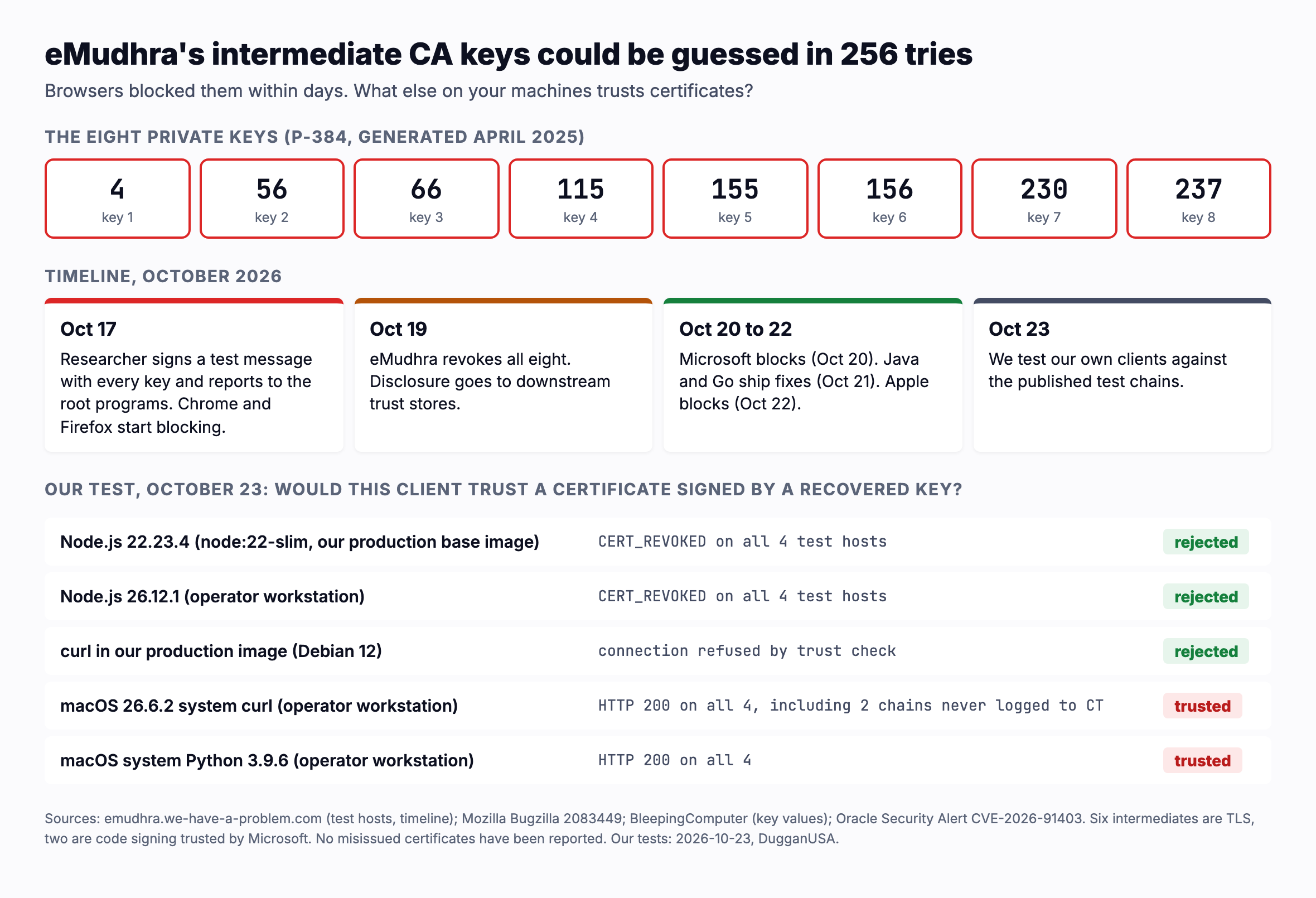
They didn't. The eight private keys were 4, 56, 66, 115, 155, 156, 230 and 237. Anyone who tried the first 256 numbers against the public certificates could recover all eight, and with them sign a certificate for any website. BleepingComputer verified that a published key matches one of the revoked certificates. eMudhra's explanation, as reported, is that a faulty step produced a second set of weak keys with labels similar to the real ones, and the weak set was picked for signing.
A researcher identified as Wayne found the problem on October 17 while scanning public certificate data. He signed a test message with each key and sent the proof to the browser root programs. Chrome pushed a block within hours, and Firefox blocked the same day. eMudhra revoked all eight on October 19. Microsoft followed on October 20 and Apple on October 22. Oracle shipped an out-of-band Java fix on October 21 as CVE-2026-91403, rated 9.1, and Go shipped CVE-2026-111943.
eMudhra says most of the certificates were never used in production and it found no certificates issued to customers from them. The public tracking site reports no Certificate Transparency entries for these intermediates since April 2025. No misissued certificates or attacks have been reported. The Mozilla bug, 2083449, is still asking whether the keys came from the hardware security module's certified generator at all.
Why "patched" is the wrong word for your fleet
Oracle's advisory reads like a TLS library bug. It isn't one. The fix in Java, Go, Node and the browsers is the same: stop trusting eight specific certificates. That only protects software that received the update or checks revocation. A great deal of software does neither. Command-line tools, language runtimes with their own certificate bundles, appliances and embedded devices tend to trust whatever chains to a root in their store, and the two roots involved stayed in many stores.
So we tested our own. A tracking site run for this incident publishes test hosts whose certificates are signed with the recovered keys, two of them with chains that were never logged to Certificate Transparency. A client that connects successfully would trust a forged certificate from anyone holding these keys, which is everyone.
- Node.js 22.23.4, the runtime in our production base image, refused all four with CERT_REVOKED. So did Node.js 26.12.1.
- curl inside our production image, on Debian 12, refused them.
- The macOS 26.6.2 system curl on our operator workstation returned HTTP 200 for all four, including both chains with no Certificate Transparency record.
- The macOS system Python 3.9.6 on the same machine also accepted all four.
The browsers on that same laptop were protected. The tools an engineer or a script uses from the terminal were not.
Update, October 24: we applied the update. It did not fix it.
We said above that a macOS update was pending on that machine and that we would retest. We did, and the answer is worse than a lag.
That laptop is now on macOS 27.0.1 — not the 26.7.1 we were waiting on, but a full major version past it. The command-line trust path is unchanged:
- System curl 8.7.1 still returns HTTP 200 on all four test hosts. It is not ambiguous about it either: the chain it accepts is issued by "C=NL; O=eMudhra BV; CN=EM DV TLS CA - G3B," one of the eight weak intermediates, and curl's own verdict on that chain is "SSL certificate verify ok."
- System Python 3.9.6 still completes the handshake on all four.
- Node.js 26.12.1 on the same machine refuses all four with CERT_REVOKED.
That is seven days after Apple's October 22 block, on a fully updated machine, across a major operating-system upgrade.
Our best read of why, offered as inference rather than established fact: both clients that still trust the keys ride Apple's older shipped crypto — system curl on SecureTransport with LibreSSL 3.3.6, system Python on LibreSSL 2.8.3 — while Apple's block reached the modern trust path that Safari and the system frameworks use. Node carries its own root store and gets it right. We have not tested Safari on that machine since the upgrade, so we are not claiming anything about the browser side today.
The useful version of this for you: do not treat an operating-system version number as an answer to "did the revocation arrive." We did, were wrong on October 23, applied the update, and were wrong again on October 24. The only thing that answered the question was connecting to the test hosts from each client and reading the result. That took about two minutes and it is the same two minutes for you.
We wrote up why this keeps happening, at this layer and in firmware, in a separate post on revocation as a distribution problem.
The code-signing half
Two of the eight were code-signing intermediates trusted by Microsoft, and that half has had less attention. A recovered code-signing key lets anyone sign a Windows binary that chains to a trusted root. Microsoft's block landed on October 20. Any binary signed under these intermediates is not evidence of anything, whatever its signing date says. If your allow-listing or EDR policy trusts signers by chain, check that it picked up Microsoft's change.
What to do
- Test from each kind of client you run, not just a browser. Connect to dv-g3b-emudhra.we-have-a-problem.com, dv-g3b-aaa-emudhra.we-have-a-problem.com, dv-g3b-noct-emudhra.we-have-a-problem.com and dv-g3b-aaa-noct-emudhra.we-have-a-problem.com. A certificate error is the good result. A page that loads means that client would trust a forged certificate.
- Update Java to the October 21 release and Go to the release carrying CVE-2026-111943. On Debian and Ubuntu, resync the Java trust store after updating ca-certificates, because the two can drift.
- On macOS, apply system updates and follow the tracking site's macOS steps for the command-line trust file. The built-in pip uses its own outdated roots.
- On Windows, the tracking site offers a PowerShell script that puts the compromised intermediates and their cross-signs in the Untrusted store. Read it before you run it, and on managed machines ask whoever runs your fleet.
- Look for anything that bundles its own CA list: containers built from old base images, Python virtual environments, appliances, IoT. They need their own update.
Addendum, October 24: a correction, a fuller test, and the part everyone is getting wrong
We went looking through public code to see who had actually applied this revocation. Three things came back, and the first one is ours.
Correction — we undercounted the roots. Above we wrote that "the two roots involved stayed in many stores." That understates it. Two roots carry the TLS intermediates: emSign Root TLS CA - G3, and AAA Certificate Services, which is Sectigo's cross-sign. The two code-signing intermediates chain to a third, emSign Root CS CA - G3. And a fourth, emSign ECC Root CA - G3, cross-signs the TLS root. Nuclei's detection template, AWS's EKS AMI distrust script and ClickHouse's hardening note all name more than two. We separated TLS from code signing earlier in this post and then wrote "two roots" in a sentence covering the whole incident. That was sloppy and the sentence stays above, uncorrected, so the error is visible.
Our own test was partial, so here is the full one. We tested four hosts on October 23 and four again on October 24. The tracking site publishes fourteen. We have now run all of them against the same machine, still on macOS 27.0.1.
All fourteen return HTTP 200. Every one of the six TLS intermediates, under both roots, including the two chains that were never logged to Certificate Transparency. Not four chains — all of them.
The eight intermediates, named, since no one else seems to list them in one place: EM DV TLS CA - G3B and G3C, EM OV TLS CA - G3B and G3C, EM EV TLS CA - G3B and G3C, and the two code-signing ones, EM OV CS CA - G3B and G3C. The B variants are eMudhra BV in the Netherlands; the C variants are eMudhra Inc in the United States.
The part everyone is getting wrong: one fingerprint per name is not enough. Each intermediate exists as more than one certificate, because each was signed by more than one root. EM DV TLS CA - G3B has SHA-256 fingerprint 42c4accd… as issued under the eMudhra root, and 45a883f3… as issued under Sectigo's AAA Certificate Services. They are different certificates with the same name. A blocklist built by looking up each name once and recording one hash will block half the chains and pass the other half, and it will look complete while doing it. The projects that got this right — ClickHouse, Peergos, and the trust-store checkers we read — all carry both. A hand-rolled list almost certainly will not. If you built one this week, go count your entries: eight names should produce more than eight hashes.
And the good news, which is most of the story. The ecosystem moved fast and moved well. Within days, distrust lists shipped in Node.js, CPython, Bun, Chromium, ClickHouse, Signal's libsignal, Docker Engine, Rancher Desktop, AWS's EKS AMI, semgrep, mitmproxy, OkHttp, Peergos, Fleet and others. Revocation propagates well when it ships as code, because code gets a release.
It fails where it lives in a trust store, because a trust store gets a manual step or nothing. ClickHouse's own changelog states the lesson better than we did: chains containing these intermediates or their roots are rejected "even if the trust store of the operating system still trusts them." They designed around exactly the failure we measured on our laptop. That is independent corroboration of the finding, from a party that has never heard of us, and it is worth more than our own receipt.
There are no network indicators to block here; the risk is in what your software trusts, not in an address. Credit to Wayne for the find and the clean proof, to the tracking site for the test hosts and for publishing all fourteen chains rather than a convenient few, and to the root programs for moving within hours.
If this was useful, or if it wasn't, the rating widget below takes ten seconds and is the only way we know.
How do AI models see YOUR brand?
AIPM has audited 250+ domains. 15 seconds. Free while still in beta.