Nvidia Was the Investor, Lender, Supplier and Backup Customer. The Chips Went Into One Big Ball Nobody Tracks
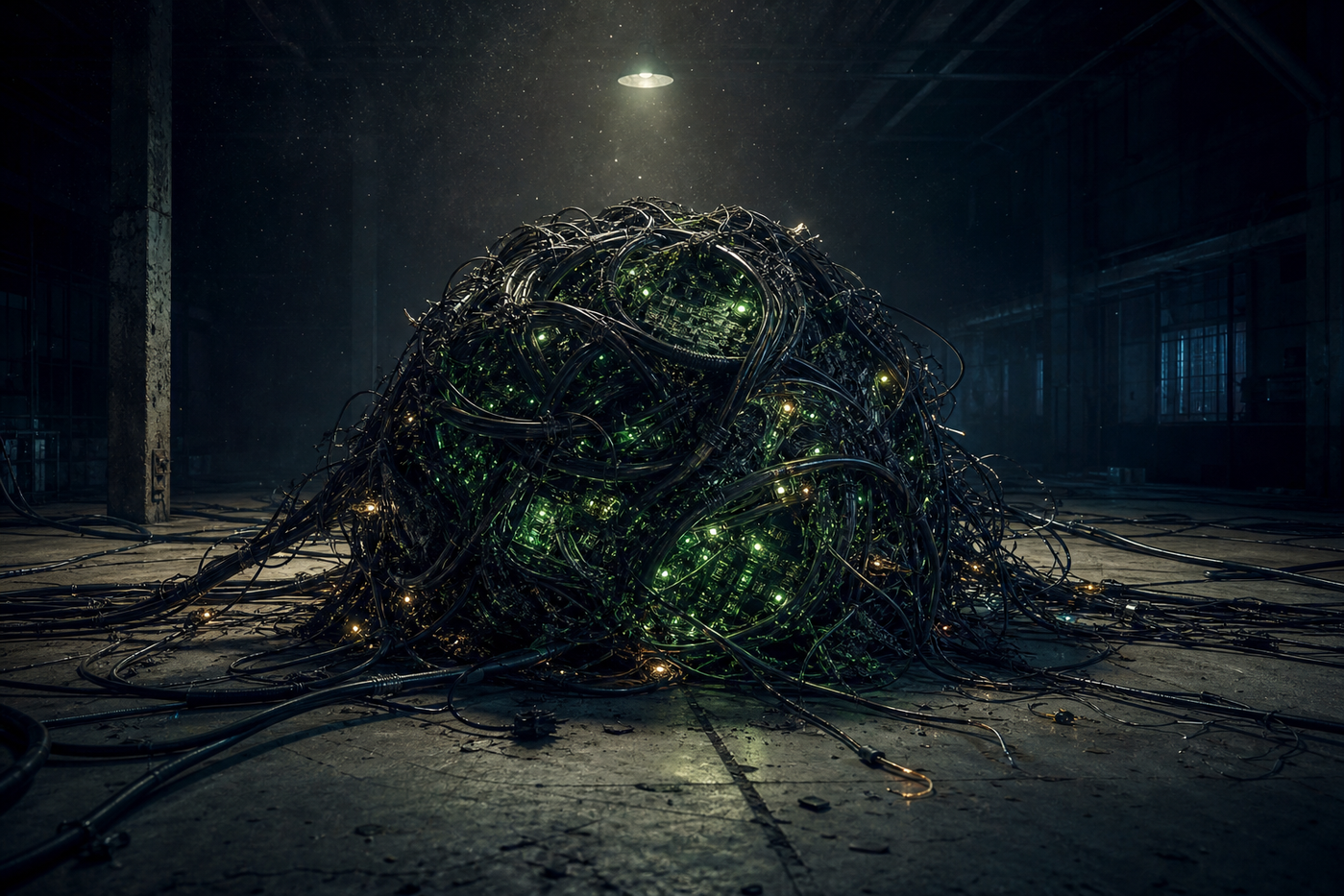
Everybody is covering the Nvidia story this week as a set of separate scandals. The CEO and the alleged spy. The son-in-law and the credit deals. The chips smuggled to China. The memory stripped off cheap boards for Huawei. North Korea training models on whatever it can find. Read them one at a time and each looks like a bad week. Put them on one page and it is one big ball, and the thread running through all of it is simple: the money is tracked to the dollar, and the hardware is tracked until the first sale and not one owner further.
Disclosure up front, because both ends of this story touch our stack: Nvidia announced an investment of up to $10 billion in Anthropic in late 2025, and DugganUSA builds on Anthropic's Claude. Everything below comes from public filings and published reporting. Where a claim is an allegation, it says so.
The money: Nvidia in four roles at once
We pulled Nvidia's own Form 10-Q for the quarter ended July 26, 2026 from SEC EDGAR and checked the numbers that have been flying around social media this week. Here is what the filing actually says.
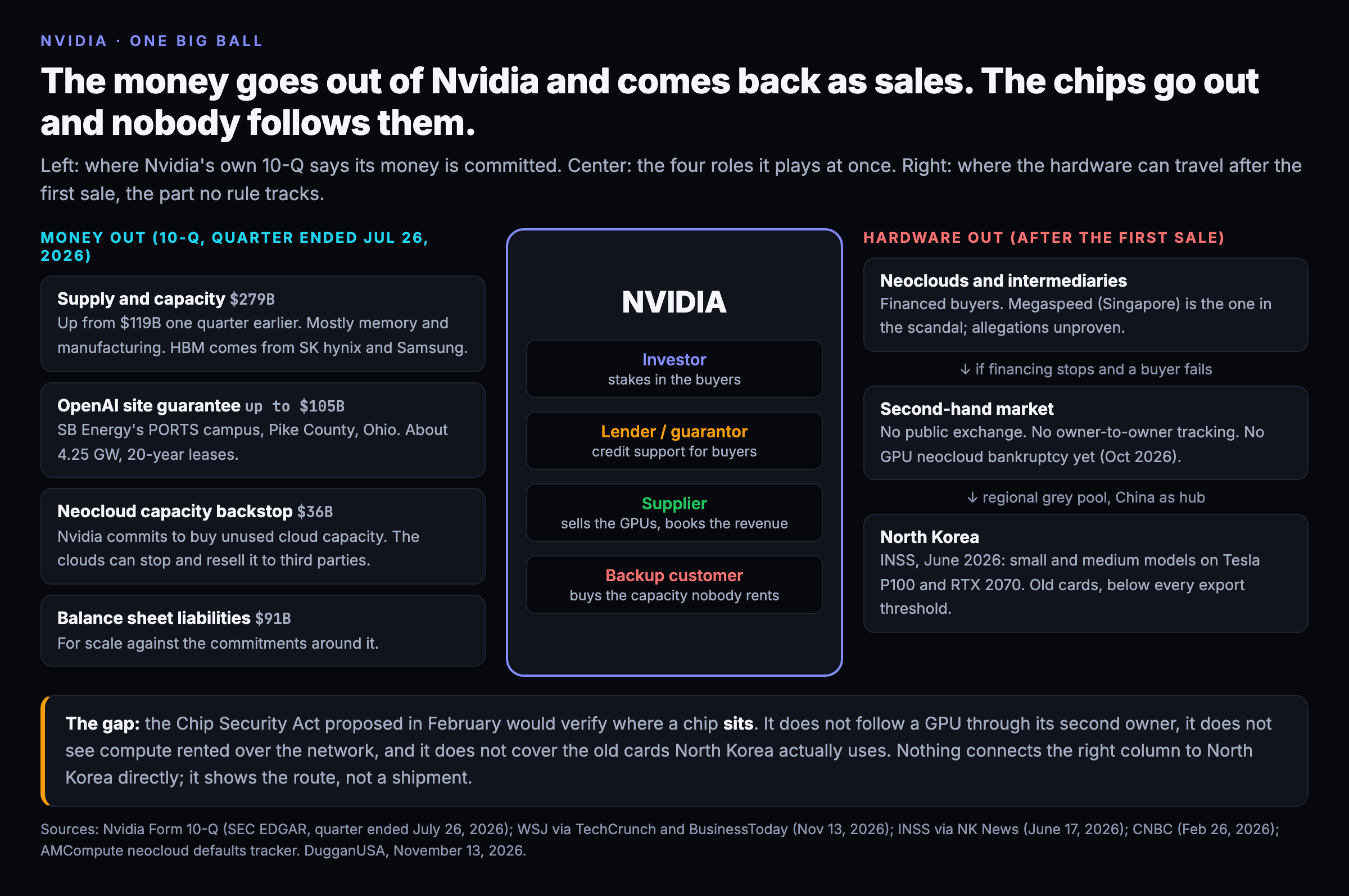
Supply commitments, mostly memory and manufacturing capacity, went from $119 billion to $279 billion in a single quarter. The filing's words: "increasing supply commitments from $119 billion last quarter to $279 billion as of July 26, 2026."
In August 2026 Nvidia entered into guarantees "capped at a total of $105 billion" for credit support on the land, power and shell buildout at SB Energy's PORTS Technology Campus in Pike County, Ohio, on behalf of an OpenAI affiliate, covering about 4.25 gigawatts under 20-year leases. The campus "will exclusively host our compute." The first of nine phases is expected in fiscal 2029.
Nvidia has also committed $36 billion to cloud service agreements with AI clouds, typically six years long. In plain words, Nvidia sells a neocloud the GPUs and then promises to buy back the capacity nobody else rents. The filing adds a detail that matters for the rest of this post: the AI clouds "can unilaterally stop providing to us and sell to third-party customers at more advantageous rates."
Against all that, total liabilities on the balance sheet are $91.3 billion, up from $49.5 billion.
So Nvidia invests in the buyer, guarantees the buyer's lease, sells the buyer the chips, books the revenue, and stands behind the buyer as the customer of last resort. The money goes out of Nvidia and comes back to Nvidia as sales. The circulating "$530 billion" figure is a sum somebody built by adding the filing's commitments table ($366 billion) to the guarantees. It is a reasonable way to add them up, but it is not a number Nvidia reports, so we are not quoting it as one.
The people: the CEO, the CFO and the son-in-law
On November 12, Jensen Huang resigned as Nvidia's CEO, effective immediately, after admitting an affair with Alice Huang, a former executive at Megaspeed, the Singapore data center company. She is suspected, per reporting from the New York Times, of having been recruited by China's Ministry of State Security. The FBI is investigating, Congress wants answers on export compliance, and China calls the whole thing a smear. The espionage allegation is unproven, and we treat it that way.
The next day, the Wall Street Journal reported (we read it through TechCrunch, BusinessToday and Seoul Economic Daily, all citing the WSJ) that Nvidia had been weighing billions in financial guarantees for cloud companies and data center builders that could not afford its chips up front, and that some of those deals were being pushed by Huang's son-in-law, Nico Caprez. CFO Colette Kress reportedly questioned how the guarantees were priced and what Nvidia got back. Huang reportedly called her "a deer in the headlights" in a summer meeting. Kress is now interim CEO. Those details come from anonymous sources and we found no on-record Nvidia response.
Megaspeed is the knot that ties the people to the hardware. Before the affair surfaced, it was already the company at the center of a reported Commerce Department smuggling inquiry that stopped after Nvidia contacted the department, and it has been described as Nvidia's largest Southeast Asian customer. Only one outlet reported the handoff, so hold that part loosely.
The hardware: tracked until the first sale
Now follow the chips instead of the money.
The policy fight has been about who is allowed to buy. In January, at Davos, Anthropic CEO Dario Amodei said that letting Nvidia sell H200s into China was "a bit like selling nuclear weapons to North Korea." In February, as CNBC reported, the House Foreign Affairs Committee advanced a bill giving Congress 30 days to review and block advanced chip sales to adversaries, and the Chip Security Act, with bipartisan support, would require exported advanced chips to carry location verification and require exporters to flag a chip that turns up somewhere unauthorized. The White House's AI czar pushed back. We have not confirmed where either bill stands today, so we describe them as proposed.
Meanwhile the memory leaked out sideways. Korean press reported this month that smugglers attach Samsung and SK hynix HBM to cheap processors to slip under the export rules, then melt the solder in China and strip the memory for Huawei, at around $4,000 a chip against roughly $1,200 legitimately. SK hynix says it has not supplied Huawei since 2020. The Korea Herald now reports that the Nvidia scandal is raising export scrutiny on Korean HBM suppliers too, which is exactly the squeeze The Diplomat warned about in March.
And then there is the other North Korea, the real one. In June, South Korea's Institute for National Security Strategy reported, from North Korean research papers that are public, that Pyongyang trains small and medium AI models on Nvidia Tesla P100 and GeForce RTX 2070 cards, and uses older Nvidia and Qualcomm chips for military, surveillance and cyber work. A P100 is from 2016. An RTX 2070 is a gaming card. Neither comes anywhere near the thresholds the export fight is about. North Korea is under a near-total embargo, so every card it holds is sanctions evasion, but the controls being argued over in Washington are aimed at H200s, not at a used gaming card bought through a broker.
Where the ball unravels
Here is the part that makes it one story. Every control on the table watches the box at the moment it is sold. Location verification tells you a chip is sitting in Singapore. It does not tell you who is renting that chip over the network. It does not follow the chip to its second owner. It does not cover the old cards that are already doing useful work for a sanctioned state.
Now run the loop backward. If the new CEO pulls back the financing, the neoclouds that depended on it have to borrow elsewhere, and the data center debt market is already nervous. As of October, the AMCompute default tracker said no GPU-focused neocloud had filed for bankruptcy. If that changes, the hardware goes to liquidation, into a second-hand market with no public exchange and no owner-to-owner record. That is the regional grey pool, with China as its hub, and per the INSS that is where North Korea shops.
Be precise about that last step: no source we found shows an H200 sold into China reaching North Korea, or ties Megaspeed to North Korea in any way. What the sources show is the route, not a shipment.
The neoclouds: the part of the ball you can't resell
Update, November 13: the neoclouds deserve their own section, because they are where the loop is tightest and where the hardware story flips.
Start with the money. On October 22, at Nvidia's GTC conference in Berlin, Jensen Huang said neocloud demand was strong but funding was the bottleneck. Nvidia was also the one supplying a lot of that funding. By October 27, the Roundhill Neocloud ETF (NCLD) was down about 30% for the year, and CoreWeave was down 36% over the month to October 22, with its reliance on debt drawing particular scrutiny (Zacks, via Yahoo Finance). On Thursday, the day Huang resigned, NCLD fell another 8.81% in a single session, per ETF Action. The broad funds hold the same ball: as of late 2025, Nvidia was about 18.5% of the VanEck Semiconductor ETF (SMH) and about 11.75% of the Global X Robotics and AI ETF (BOTZ). Those weights move, but the point holds. If you own a semiconductor or AI fund in a retirement account, you own a piece of the loop.
Now try to buy the hardware. Go looking for a used GB200 or GB300 NVL72 rack on the secondary market and you find almost nothing. One GPU vendor put it plainly in June: "You can't buy a used one because nobody is done with theirs." There was "essentially no secondary market for GB300 or Blackwell-Ultra parts," because none had come off contract. The used market that does exist is a generation or two back: H100s, A100s, individual cards.
That changes the shape of the risk. An NVL72 is 72 GPUs and 36 Grace CPUs in one liquid-cooled rack drawing well over 100 kilowatts. It does not fit in a shipping box to Pyongyang, and it does not run in a basement. If a neocloud that bought these on Nvidia-backed credit fails, the racks do not trickle onto an auction site. They stay where they are and change hands with the building, the lease and the power contract, to whoever buys the distressed company. So there are two failure modes, not one:
- The older generation, H100s and A100s and gaming cards, is liquid. It moves through brokers, owner to owner, with no record. That is the grey pool, and it is what North Korea runs on.
- The newest generation is stuck in place. The question there is not where the box goes. It is who ends up owning the data center, and who they rent it to over the network. A location check will report the rack hasn't moved while someone new rents it from anywhere.
Either way, the controls on the table watch the first sale. The neoclouds are where the second owner shows up.
What a defender can do with this
None of this is abstract if you run infrastructure, because the cheapest way for a sanctioned actor to get compute is not to smuggle a box. It is to rent one, or to steal someone else's access to one.
If you sell GPU capacity, know your customer the way a bank has to. Identity checks on new accounts, payment provenance, and a hard look at who is renting at volume through layers of resellers. North Korean IT workers already operate under borrowed identities; a neocloud trying to fill idle capacity is exactly the counterparty they look for.
If you buy GPU capacity or hold AI API keys, treat those credentials as money, because they are metered compute. Stolen cloud keys and API keys are how someone else trains or runs models on your bill. Rotate them, scope them, alert on spend you did not plan, and never leave them in a repository or a client-side bundle.
If you buy used data center GPUs, ask for the chain of ownership and the serial numbers, and keep the records. Right now you may be the only one keeping them.
And if you write policy, the gap is not the first sale. It is every sale after it, and every hour of compute that never leaves the rack.
Sources
- Nvidia Form 10-Q for the quarter ended July 26, 2026, SEC EDGAR: https://www.sec.gov/Archives/edgar/data/1045810/000104581026000075/nvda-20260726.htm
- CBS News, Nvidia CEO Jensen Huang resigns: https://www.cbsnews.com/news/nvidia-ceo-jensen-huang-resigns/
- Washington Post, Jensen Huang resigns as Nvidia CEO after affair with alleged spy: https://www.washingtonpost.com/technology/2026/11/12/nvidia-board-weighs-jensen-huangs-future-after-affair-with-allege-chinese-spy/
- TechCrunch, Jensen Huang didn't show confidence in his successor: https://techcrunch.com/2026/11/13/jensen-huang-didnt-show-confidence-in-his-successor-report-says/
- BusinessToday, Kress challenged Huang's AI financing bets: https://www.businesstoday.in/technology/news/story/nvidia-interim-ceo-colette-kress-challenged-jensen-huangs-ai-financing-bets-before-his-exit-567370-2026-11-13
- Fortune, 2 scandals, 1 destination: https://fortune.com/2026/11/10/2-scandals-1-destination-why-nvidia-cant-shake-china-smuggling-allegations
- Bloomberg, Anthropic CEO says AI chip sales to China like selling nukes to North Korea: https://www.bloomberg.com/news/articles/2026-01-20/anthropic-ceo-says-selling-advanced-ai-chips-to-china-is-crazy
- CNBC, Congress takes on Nvidia, White House as it pushes for chip export limits: https://www.cnbc.com/2026/02/26/congress-pushes-back-on-nvidia-white-house-with-chip-export-limits.html
- The Diplomat, Nvidia export curbs cloud South Korea's chip outlook: https://thediplomat.com/2026/03/nvidia-export-curbs-cloud-south-koreas-chip-outlook-fueling-chinas-ai-ambitions/
- Seoul Economic Daily, Smugglers melt solder to strip Korean HBM for Huawei: https://en.sedaily.com/world/2026/11/03/smugglers-melt-solder-to-strip-korean-hbm-for-huawei
- Korea Herald, Nvidia scandal raises export risks for Korean chipmakers: https://www.koreaherald.com/article/10930899
- NK News, North Korea uses older Nvidia, Qualcomm tech to boost AI capabilities: https://www.nknews.org/?p=973167
- AMCompute, GPU and neocloud defaults: https://www.amcompute.com/gpu-risk/defaults
- Zacks via Yahoo Finance, Neocloud ETF down 30% YTD despite strong demand (October 27, 2026): https://finance.yahoo.com/technology/ai/articles/neocloud-etf-down-30-ytd-110000804.html
- ETF Action, Nvidia shakeup rattles tech (November 13, 2026): https://www.etfaction.com/nvidia-shakeup-rattles-tech-as-energy-and-crude-outperform
- Zacks, Nvidia weights in SMH and BOTZ (November 2025): https://www.zacks.com/stock/news/2931898/tech-etfs-to-buy-as-nvidia-sets-foot-into-pc-market-via-new-ai-chip
- Pantheon, The H100 cliff that isn't, a vendor's read of the GPU resale market (June 25, 2026): https://pantheon.run/research/h100-cliff-gpu-secondary-market
How do AI models see YOUR brand?
AIPM has audited 250+ domains. 15 seconds. Free while still in beta.
Audit your site now → aipmsec.com
Was this useful? Thirty seconds, no cookies, no tracking, no third parties, your address hashed and never stored. The question lives here: https://analytics.dugganusa.com/nps.html#post=nvidia-one-big-ball-investor-lender-supplier-chips-nobody-tracks