Northflank Says Assume Every Secret You Stored There Was Decrypted. Here Is the Order to Rotate Them In.

If you run workloads on Northflank, rotate every secret stored there now, starting with your AI provider keys. On October 30 the platform told customers to "assume all environment variables have been decrypted" and to disable and rotate all keys. Northflank has confirmed customer reports of unauthorized use of AI API keys supplied to the platform. It has not said how the attackers got in.
What was reported
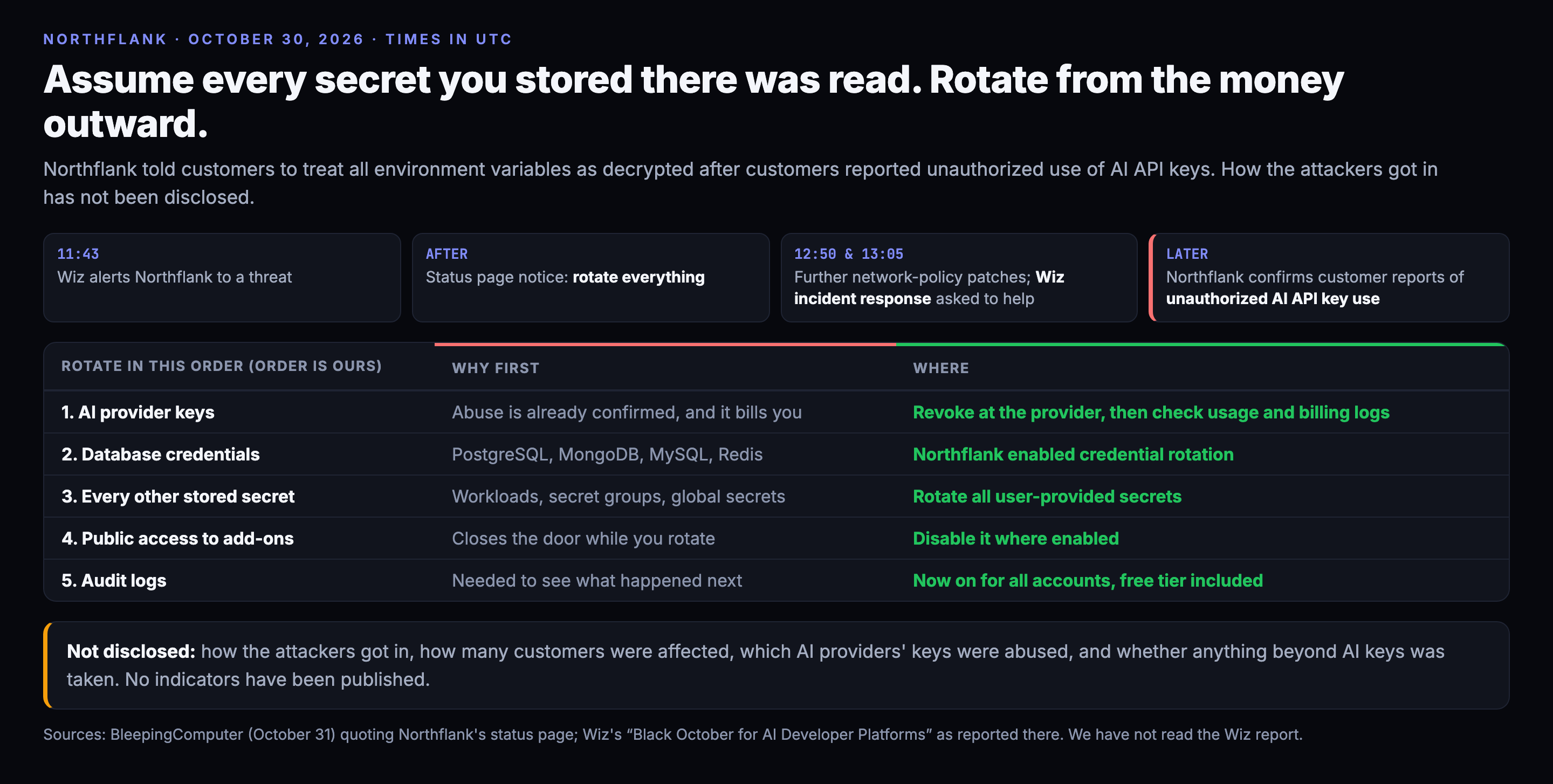
According to BleepingComputer on October 31, Wiz alerted Northflank to a threat at 11:43 UTC on October 30. Northflank posted the incident on its status page and told customers to rotate environment variables and API keys. It patched its network policy, patched again at 12:50 and 13:05, and asked Wiz's incident response team for help. Later it confirmed that users had reported "unauthorised use of AI API keys supplied to the Northflank platform."
The decrypted-secrets line is a precaution. The reporting does not say the secrets were actually accessed or taken. A platform that stores your secrets can only tell you to assume the worst, because it cannot easily prove which ones were read.
Northflank's own instructions to customers were to rotate all user-provided secrets, review AI provider usage and billing logs, report suspicious usage to Northflank and to the AI providers, rotate secrets in workloads, secret groups and global secrets, and disable public access to add-ons where enabled. It turned on credential rotation for PostgreSQL, MongoDB, MySQL and Redis, and turned on audit logs for every account, free tier included.
The order to rotate in
The list above is Northflank's. The ordering below is ours, so weigh it accordingly.
- AI provider keys first. Abuse of these is already confirmed, and the cost lands on your account. Revoke them at the provider, not only inside Northflank, then read the provider's usage and billing logs for the last several days.
- Database credentials next. Use the rotation Northflank just enabled, and confirm each application reconnects with the new value before you delete the old one.
- Every other stored secret. Third-party API tokens, signing keys, webhook secrets and anything in a secret group or global secret.
- Close public access to add-ons while you work, where you had it open.
- Turn on and read the audit logs. They did not exist for some accounts until now, so they will only show what happens from here.
Two controls help the next time this happens, whichever platform it is:
- Spend caps and usage alerts on every AI key. A stolen inference key is metered theft. A cap turns an open-ended bill into a bounded one.
- One key per workload and environment, with the narrowest scope the provider allows. Then one leaked value costs one thing and not everything.
The wider count
BleepingComputer reports that Wiz's research, titled "Black October for AI Developer Platforms," identified at least nine incidents at AI development platforms in October. Platforms named there include Northflank, Railway, OpenCode, Warp and Lightning AI. By that account, Railway's involved possible exposure of decrypted environment variables, OpenCode exposed AI API keys, and Warp exposed AI agent logs and user telemetry. Wiz says attackers in some incidents targeted environment variables holding AI credentials, which it links to LLMjacking, the use of stolen credentials to run AI workloads on someone else's account. Wiz has not confirmed that all nine involved the same attackers, and we have not read the Wiz report ourselves.
Note the name: this is Wiz's October, not the vulnerability-count piece we published on October 29.
What we hold, and what we don't
Nothing. The reporting we read publishes no IP address, domain or hash, so there is nothing to put in a feed. We did not confirm the Northflank breach from our own data.
This is one more case of a theme we published today, Borrowed Credit: a platform that holds other people's secrets is a single place to steal many tenants' keys at once.
Limits
This rests on one BleepingComputer article quoting Northflank's status page. We did not read the status page or the Wiz report directly. The cause, the customer count and which AI providers were hit are all undisclosed. One vendor blog we saw claimed the stolen keys are being resold, and we could not verify it, so we left it out.
Five percent of this is wrong somewhere. It always is. The numbers will move again before you finish reading.
Was this useful? Rate this post. The widget is at the bottom of the page, and we read every response.
Every indicator in this post is in the feed. Free.
1.58M+ IOCs, STIX 2.1 / TAXII, 88% novel vs ThreatFox, exploited-CVE leads ahead of CISA. No credit card — a free API key in 30 seconds, and you can audit every claim above against the live endpoints.