N-able N-central: 33 Claimed Unpatched Flaws With Public Exploit Code, No CVEs, No Reported Exploitation. Keep Its Management Interface Off the Internet

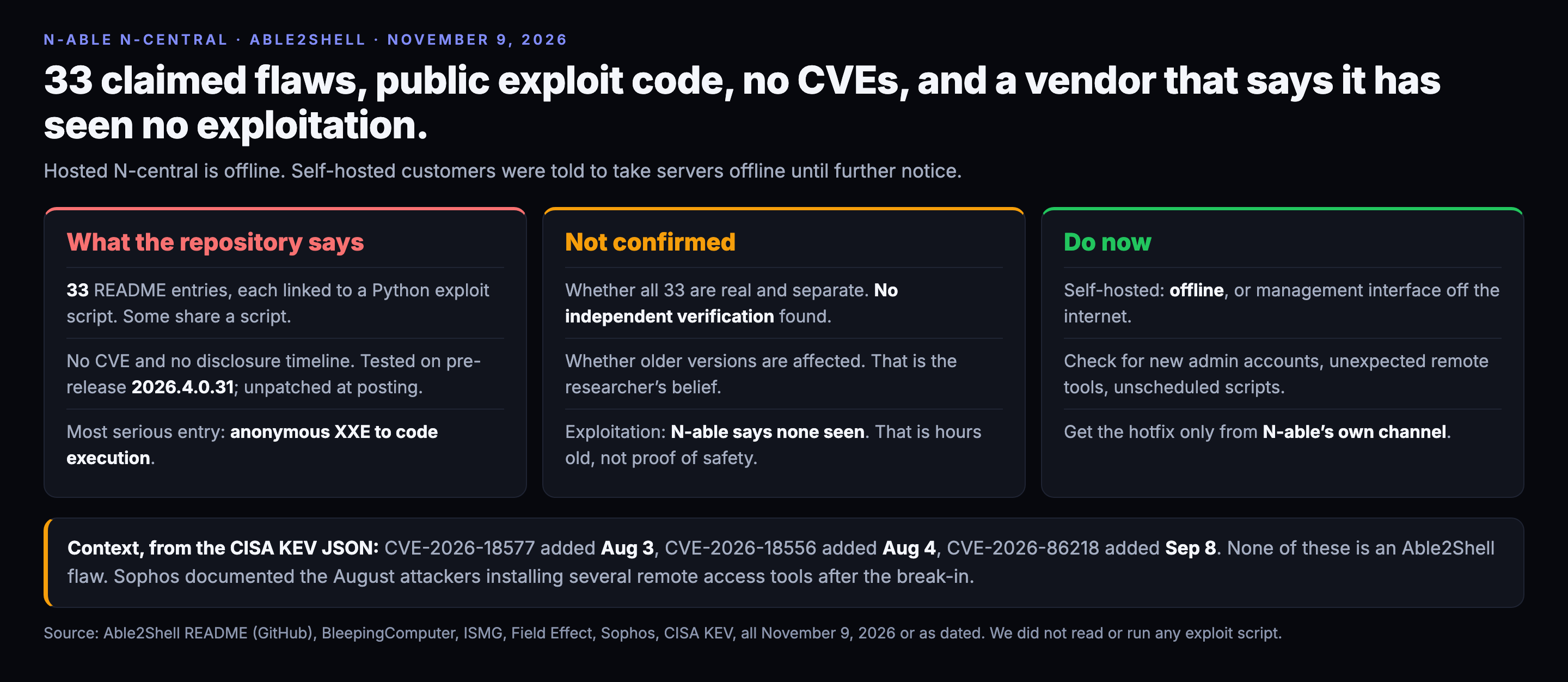
If you run N-central on your own server, follow N-able's instruction to take it offline until further guidance, or at minimum make sure its management interface is not reachable from the internet. If you use the hosted service, it is down, so the work is to plan for your remote management being unavailable and to prepare to check what N-central can reach once it returns. N-able says it has not seen these flaws exploited. Public exploit code for all of them has been out since November 8, and CISA has added three other N-central flaws to its exploited list since August.
What is confirmed
We read the repository itself, not only the press.
- A GitHub repository called Able2Shell, under an account named Oracle-Security, lists 33 claimed vulnerabilities in N-central, each linked to a Python proof-of-concept script. The README states no CVE for any of them and no disclosure timeline. It says everything was tested on N-central Appliance 2026.4.0.31, a pre-release version, that the issues "should work on previous versions, including the most up to date version", and that at the time of posting all are "unpatched".
- The titles in the README include an anonymous XXE flaw chained to code execution as the nable user, a stack overflow in a component called GenericTCP that gives root command execution to an authenticated product administrator, a pre-authentication XXE that steals a session and writes a JSP file, anonymous disclosure of database and agent credentials, unauthorized technician account creation, and several routes from cross-site scripting or file upload to code execution.
- Researcher Sean Bales announced the release on LinkedIn, according to BleepingComputer and Information Security Media Group (ISMG). We did not confirm ourselves that the Oracle-Security account is his. He told BleepingComputer the discovery was AI-assisted.
- N-able took its hosted N-central environment offline and, in ISMG's account, declared an active incident at 15:15 UTC on November 9. It told customers running N-central on their own servers to take them offline "until further notice". Its statement: "at this time, we have not seen any active exploitation of these vulnerabilities". It says a hotfix is coming "soon" and, per BleepingComputer, plans updates every four hours.
- Field Effect and ISMG report the same offline action and the same no-exploitation statement.
What is not confirmed
- Whether the 33 are real, separate and unpatched. ISMG says it found no independent verification of any exploit, and BleepingComputer says it has not verified all of them. Some entries share one script, so 33 is a count of README entries, not necessarily of distinct bugs. ISMG's headline says 33 and its body says "over 30".
- Whether older versions are affected. That is Bales's belief. ISMG notes a comment where he suggested many also work on released versions, which he later deleted.
- Whether anyone is exploiting these. N-able says no. An MSP quoted by ISMG on Reddit says it has seen no related activity. That is an absence of reports a few hours after release, not evidence of safety.
- The disclosure dispute. Bales says he published because N-able did not respond to him and left two unrelated RCEs and a privilege-escalation flaw unpatched for five to six months. N-able did not answer BleepingComputer on that. We cannot verify either side.
Why this product matters beyond its bug count
N-central is a remote monitoring and management tool. It holds the keys to the customers it manages, so a flaw in it is access to every machine and credential it touches.
CISA's Known Exploited Vulnerabilities catalog, which we read directly today, lists these N-central entries this year: CVE-2026-18577 (authentication bypass and account takeover, added August 3), CVE-2026-18556 (the flaw CVE-2026-18577 was an incomplete patch for, added August 4), and CVE-2026-86218 (pre-authentication code injection leading to remote code execution, added September 8). Two older entries, CVE-2025-8875 and CVE-2025-8876, were added in August 2025. None of these is an Able2Shell flaw.
Sophos documented what the August attackers did with that access: created a domain account named "veeam", reset domain administrator passwords, installed several remote access tools including AnyDesk, TacticalRMM, TeamViewer, RustDesk, SimpleHelp and HopToDesk, installed Cloudflare Tunnel binaries renamed to look like Microsoft files, and used an EDR-killing tool before reaching backup servers and domain controllers. That was a different set of bugs from Able2Shell. We cite it because it shows what a successful N-central compromise looked like in practice, and therefore what to look for.
ISMG counts the coming hotfix as the fifth emergency N-central hotfix since August 1. That count is theirs; we have not reconciled it against N-able's release notes.
What to do
- Self-hosted N-central: follow N-able's instruction to take the server offline until further notice. If you cannot, confirm the management interface is reachable only from a dedicated administration network, not the internet. Field Effect gives the same advice.
- Hosted N-central: expect no service. Work out how you will handle patching, alerts and remote access until it returns.
- Before you bring anything back, check for what the August attackers did: new or unexpected administrator accounts, new domain accounts such as "veeam", unexpected remote access tools, cloudflared binaries with Microsoft-style names, and script executions you did not schedule. Look especially at the period just before systems went offline.
- Inventory what N-central can reach: domain controllers, hypervisors, backup servers, identity providers. If you find misuse, rotate the credentials and integration secrets stored in or reachable from it.
- When N-able publishes the hotfix, read its notes first and get it from N-able's own channel. Treat a "patch" link from anywhere else as hostile for the next few weeks.
- For indicators, use Sophos's August list for that campaign. No indicator list exists for Able2Shell.
How we know, and how we checked
We read the Able2Shell README on GitHub, BleepingComputer, ISMG, Field Effect, the Sophos write-up of the August campaign, and the CISA KEV JSON. We did not run, download or read any of the exploit scripts. N-able's own status pages returned no incident text when we fetched them, so every N-able statement here is quoted through the outlets. The Sophos article shows no publication date. No edge check was run: these flaws sit behind a management interface we do not host. We did not add indicators to our feed: Able2Shell publishes none, and the Sophos indicators describe an earlier campaign that we have not reviewed for this post.
Sources
BleepingComputer, "N-able takes cloud platform offline after 30+ 'zero-days' published," November 9, 2026. Information Security Media Group, "N-able Takes Platform Offline After 33 Zero-Days Drop," November 9, 2026. Field Effect, "N-able takes N-central offline as alleged zero-day exploits surface." Sophos, "N-able N-central exploitation results in RMM tool deployment." CISA Known Exploited Vulnerabilities catalog. Able2Shell README on GitHub.
Every indicator in this post is in the feed. Free.
1.58M+ IOCs, STIX 2.1 / TAXII, 88% novel vs ThreatFox, exploited-CVE leads ahead of CISA. No credit card — a free API key in 30 seconds, and you can audit every claim above against the live endpoints.