A Researcher Published Working Exploits for More Than 30 N-central Flaws With No Warning. N-able Took Its Hosted Service Offline and Told On-Premises Customers to Switch Servers Off

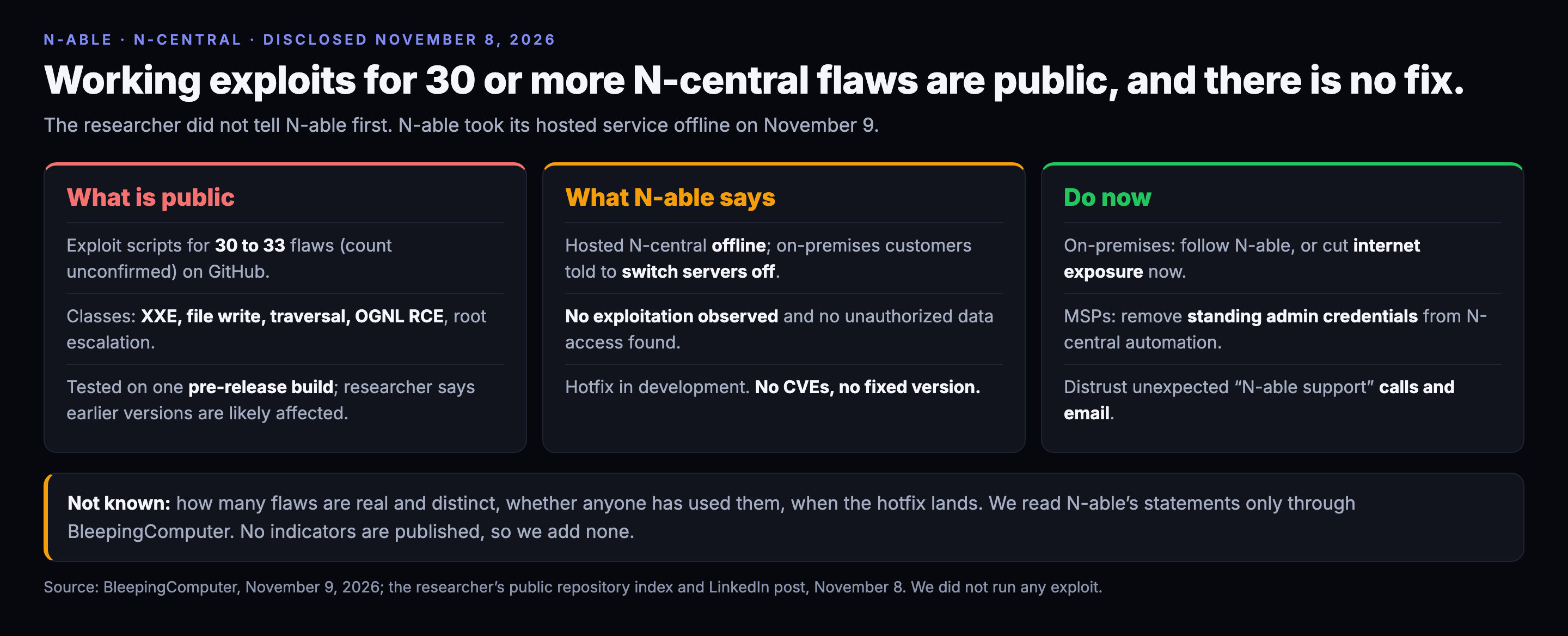
If you run N-able N-central on your own servers, N-able's current instruction, as BleepingComputer quotes it, is to take those servers offline until further notice. If you are a customer of N-able's hosted N-central, the service has been down since November 9. A researcher published exploit code for more than 30 flaws on November 8 without telling the vendor first. N-able says it has seen no exploitation. There is no hotfix and no CVE yet.
What has been reported
The sources are BleepingComputer's report of November 9 (Lawrence Abrams), the researcher's public GitHub repository (an agent read the index and most of the README for us), and the researcher's LinkedIn post. N-able's status page would not load for our reader, so every N-able statement below comes from BleepingComputer's quotes.
- What was published: late on Sunday, November 8, a single independent researcher posted a repository with working exploit scripts, captured output and screenshots for N-central flaws. BleepingComputer says "more than 30"; the repository's index, as read for us, lists 33 entries, while a summary of the unread end of the README suggested fewer, so we say 30 to 33 and unconfirmed. BleepingComputer has not independently verified all of them. The researcher told BleepingComputer the discovery was AI-assisted.
- What kinds: unauthenticated XML external entity attacks, credential disclosure, arbitrary file write, path traversal, cross-site scripting, a code-injection class called OGNL, a stack overflow, and root privilege escalation. The one BleepingComputer calls most critical is an unauthenticated XXE chain that steals a trusted local session, resets an account password and runs commands as the application user, including creating an enabled default administrator account. One root exploit needs a logged-in product administrator and a specific lab setup.
- Versions: the researcher tested only a pre-release N-central appliance build, 2026.4.0.31, and says most or all of the flaws should work on earlier versions, including the latest release. No other version is named.
- No coordination: the researcher says they did not disclose these to N-able before posting. They also say they reported other, unpublished flaws about five to six months ago and got no reply for weeks. Those are his claims and BleepingComputer says N-able did not address them.
- N-able's response, per BleepingComputer's quotes: it "took our Hosted N-central environment offline today, November 9," across the Americas, Europe and Asia-Pacific, and told on-premises customers to "temporarily take their servers offline until further notice." It says it has "not observed active exploitation" and has found no evidence of unauthorized data access. A hotfix is being developed and validated. N-able's login and its other services stay up. No restore estimate has been given.
- Exploitation in the wild: none claimed by anyone in what we read. That can change quickly with public scripts.
- Identifiers: no CVE numbers appear in the report, the repository index we read or the LinkedIn post. The repository's exploit file names describe the attack and are visible to anyone, so we do not list them.
What it means
N-central is a remote management platform for managed service providers. One server there reaches the computers of many client companies. That is why a public exploit for it matters more than for most products, and why N-able chose to switch the hosted service off rather than wait. Our KEV index already holds earlier N-central entries added in August and September, so attackers have shown interest in this product this year. The honest position today is narrow: working code is public, a fix is not, and the vendor says nobody has used it yet.
What to do
- On-premises N-central: follow N-able's instruction to take the server offline until it publishes a hotfix. If the server cannot go offline, remove its internet exposure now and allow only a management network or VPN.
- Assume the public scripts work against your version until N-able says otherwise. Do not read "tested on a pre-release build" as "your build is safe".
- Hosted customers: expect the service to be down. Have a manual way to reach critical clients, and do not trust unexpected emails or calls from "N-able support" about restoring service.
- If you are an MSP, check what the N-central server can do to your clients: remove standing domain-admin credentials from any automation it holds, and confirm you can isolate it without losing the ability to manage a client in an emergency.
- Look for what exploitation would leave: new administrator accounts in N-central, password resets you did not request, and unexpected files in the application's temporary directory. We have no confirmed indicators to give you, because none are published.
- Watch N-able's status page and release notes for the hotfix, and apply it before bringing the server back.
What is not known
How many of the flaws are real and distinct, and which versions they affect. Whether anyone has used them. When the hotfix arrives. Whether N-able will assign CVE numbers. Whether the researcher's claim about earlier unpatched reports is accurate. We could not read N-able's own status entries.
How we know, and how we checked
We read BleepingComputer's report, the researcher's repository index and most of its README, and the LinkedIn post, through an agent. We did not run any of the exploits and do not link the repository. We checked our KEV index and our blog index: the KEV holds earlier N-central entries, and we found no earlier post of ours on this disclosure. We did not run an edge check: no N-central web path is published in what we read, so there is nothing to match, and we run no N-central. We add no indicators to our feed: none are published.
Sources
BleepingComputer, "N-able takes cloud platform offline after 30+ zero-days published," Lawrence Abrams, November 9, 2026. The researcher's public GitHub repository and LinkedIn post, November 8, 2026. The Hacker News, "N-able Takes N-central Cloud Offline After Researcher Discloses 33 Zero-Days with PoC Exploits," November 10, 2026 (headline only; not read in full).
Every indicator in this post is in the feed. Free.
1.58M+ IOCs, STIX 2.1 / TAXII, 88% novel vs ThreatFox, exploited-CVE leads ahead of CISA. No credit card — a free API key in 30 seconds, and you can audit every claim above against the live endpoints.